Showing posts sorted by relevance for query paradise. Sort by date Show all posts

Wednesday, January 16, 2013

Paradise Revisited

Tuscany, Italy-trekearth

Paradise Revisited

Revised December 11, 2020

Paradise from the New Testament Greek


Strong page 1035.


Strong page 72. 


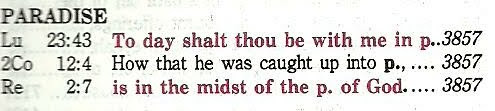
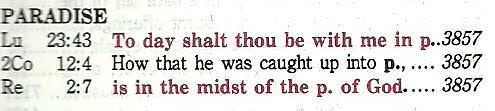
Marshall page 257. Paradise from Luke 23:43.


Marshall page 545. Paradise from 2 Corinthians. I tried to include more text but the way the book fit on the scanner it was distorted.


Marshall page 727. Paradise from Revelation 2: 7.

Commentary


Bauer on page 614 describes paradise from Luke 23, 2 Corinthians 12 and Revelation 2 as a place above the earth. Now from my philosophical/theological perspective I do not take this plain literally, as in some place in the clouds, or above the clouds, or even beyond the solar system or beyond the physical Universe, as in a place that can be physically found via space/travel.

The Bible teaches that paradise is a place where spirits in Christ go after death, and Old Testament/Hebrew Bible saints went to spiritually after death.

The Bible teaches this using figurative literal language.

Therefore, I would conclude paradise is a place of the non-physical spiritual realm.

Now, in discussion at church and with my theological/philosophical friends over the years I have speculated that because human beings are used to and made for physicality, Paradise may consist of, and I state may consist of, a simulated physicality that seems like earth to the persons that are there.

On the other hand there is the school of thought that when one dies in Christ he or she may almost immediately awaken in the resurrected body making the paradise references strongly metaphorical as opposed to figurative literal. This will not be immediate, but will seem to be.

This is certainly orthodox and possible, but I question whether Jesus meant this by the use of 'today' to the criminal on the cross. Strong notes that it has to do with now and present. Strong (1890)(1986: 87).

There is a textual and theological possibility that the Revelation 2: 7 reference is in regard to a future, plain literal restored Eden like planet earth.

This would be a different 'paradise'.

There is also the issue of Paul's 2 Corinthians reference and his willingness to consider departing the body to be with the Lord in Philippians 1.

H. A. Kent Jr. reasons the term 'paradise' although appearing in the Greek New Testament is probably originally of Persian origin. Kent (1996: 826). In Judaism, rabbinic literature used the term as a place to portray the place of blessedness for the righteous dead that knew God, in contrast to those that did not. Kent (1996: 826).

Some scholars have concluded that since the remaining references to paradise after Christ and the cross with Luke 23, refer to Heaven, and then was the resurrection and Christ's ascension, that Paradise has been removed from Hades and taken to the third heaven. Kent (1996: 826).

This seems rather speculative. By my reasoning with my own speculation if paradise would be a simulated realm like earth with simulated physicality for those in Christ and Old Testament Saints, the exact location is a rather irrelevant point, I suppose.

Erickson reasons that based on the same Biblical evidences the righteous in the intermediate state arrive at paradise. Erickson (1994: 1183). The intensity of the condition of paradise and Hades will not be as intense as the finalized states. Erickson (1994: 1183). This would be not only a reasonable theological and philosophical deduction based on the fact it is intermediate state and pre-final judgment (2 Corinthians 5 and Revelation 20 respectively) but also these are simply spiritual states and not spiritual/physical states. As Erickson notes the human condition is incomplete. Erickson (1994: 1183).

I was listening very recently to a well-known online/radio teacher discuss this topic and he suggested when asked that persons in Heaven/Paradise would not be aware of what was occurring in the earthly realm. This despite such verses, as he noted, Hebrews 12: 1 and the cloud of witnesses. This appears figurative language and from his Hebrews commentary, Hughes notes that dramatic imagery is being used. Hughes (1990: 518).  Those mentioned are past martyrs who are champions of faith. Hughes (1990: 518). The online/radio teacher also pointed this out, and this would be a preferred interpretation to a suggestion that they somehow are monitoring occurrences in the earthly realm.

I doubt there is a direct line of access from realm to realm, but I suppose this does not rule out, since paradise would be a supernatural realm, God providing certain information to citizens by his will and choice or because he was asked and is therefore perhaps willing to do so.

Of course this realm in not empirical and is non-scientific and so for many critics it will seem like a ridiculous nonsense concept. The same support for it would come from the same religious history from Scripture written by several authors in different locations with different books that wrote the same basic theology. And as I noted to an advisor at Manchester that doubted the existence of angelic beings because they were non-physical, if God being of spirit (John 4: 24) could make physical rational beings, then he could also make spiritual rational beings. If God could create a physical universe of matter, a physical realm for finite creatures, then he could also create a spiritual realm for finite creatures.  Not theologically, or philosophically huge difficulties in reality.

BAUER, W (1979) A Greek-English Lexicon of the New Testament, Translated by Eric H. Wahlstrom, Chicago, The University of Chicago Press.

ERICKSON, MILLARD (1994) Christian Theology, Grand Rapids, Baker Book House.

HUGHES, PHILIP, EDGCUMBE (1990) A Commentary On The Epistle To The Hebrews, Grand Rapids, William B. Eerdmans Publishing Company.

KENT H. A. (1996) ‘Paradise', in Walter A. Elwell (ed.), Evangelical Dictionary of Theology, Grand Rapids, Baker Books.

MARSHALL, ALFRED (1975)(1996) The Interlinear KJV-NIV, Grand Rapids, Zondervan.

STRONG, J. (1890)(1986) Strong's Exhaustive Concordance of the Bible, Pickering, Ontario, Welch Publishing Company.

Saturday, January 17, 2015

Paradise: Third Post

Amalfi Coast, Italy-Facebook-Travel+Leisure

I was listening Friday afternoon to an online Pastor. He stated basically the following view, although in the context of Luke 16, which I noted in the 2013 article:

Some scholars have concluded that since the remaining references to Paradise after Christ and the cross with Luke 23, refer to Heaven, followed by the resurrection and Christ's ascension, that Paradise has been removed from Hades...Kent (1996: 826).

The Pastor stated that the Hell section of Hades remains, although not the final place of judgment, that being the lake of fire (Revelation 20).

The implication being that Paradise was now non-existent in the New Testament context, replaced by Heaven.

What was not mentioned by the speaker was the view that Paradise has been removed from Hades and taken to the third heaven. Kent (1996: 826).

This appears Biblical in light of 2 Corinthians 12.

For fairness I will note that none of us presenting theological and Biblical works, unless presenting specific academic theses are presenting exhaustive works with articles and in the case of Pastors, sermons.

There is the issue of Paul's 2 Corinthians reference and his willingness to consider departing the body to be with the Lord in Philippians 1.

Erickson reasons that based on Biblical evidences the righteous in the intermediate state arrive at Paradise. Erickson (1994: 1183). The intensity of the condition of Paradise and Hades will not be as intense as the finalized states. Erickson (1994: 1183). This would be not only a reasonable theological and philosophical deduction based on the fact it is intermediate state and pre-final judgment (2 Corinthians 12 and Revelation 20 respectively) but also these are simply spiritual states and not spiritual/physical states. As Erickson notes the human condition is incomplete. Erickson (1994: 1183).

By my reasoning and speculation, Paradise could be a simulated spiritual realm like earth with simulated physicality.

Heaven and also Paradise could be one and the same perhaps with a new location after the resurrection of Christ.

The exact location is a rather irrelevant point as it is a spiritual realm and by my speculation, perhaps with simulated physicality.

The New Testament version of Paradise now featuring the presence of the Lord.

For the sake of argument, did the Old Testament version of Paradise never feature the Lord's presence?

This seemed to be the assumption of the Pastor.

Ephesians 4:7-10 is used by some scholars for possible support for Jesus Christ setting the Hebrew Bible Saint captives free:

New American Standard Bible (NASB)

7 But to each one of us grace was given according to the measure of Christ’s gift. 8 Therefore [a]it says, “When He ascended on high, He led captive a host of captives, And He gave gifts to men.” 9 (Now this expression, “He ascended,” what [b]does it mean except that He also [c]had descended into the lower parts of the earth? 10 He who descended is Himself also He who ascended far above all the heavens, so that He might fill all things.)

Footnotes: Ephesians 4:8 Or He Ephesians 4:9 Lit is it except Ephesians 4:9 One early ms reads had first descended New American Standard Bible (NASB) Copyright © 1960, 1962, 1963, 1968, 1971, 1972, 1973, 1975, 1977, 1995 by The Lockman Foundation

Based on Scripture I can see the theological reasoning that Paradise may have now been relocated so those within now fully experience the presence of the Lord in Paradise/Heaven.

But does not mean that the Lord was never experienced at all in Paradise previously?

This seems speculative and questionable.

Would it be Biblically Paradise without at least some divine communication?

ERICKSON, MILLARD (1994) Christian Theology, Grand Rapids, Baker Book House.

HUGHES, PHILIP, EDGCUMBE (1990) A Commentary On The Epistle To The Hebrews, Grand Rapids, William B. Eerdmans Publishing Company.

KENT H. A. (1996) ‘Paradise', in Walter A. Elwell (ed.), Evangelical Dictionary of Theology, Grand Rapids, Baker Books.

MARSHALL, ALFRED (1975)(1996) The Interlinear KJV-NIV, Grand Rapids, Zondervan. 

STRONG, J. (1890)(1986) Strong's Exhaustive Concordance of the Bible, Pickering, Ontario, Welch Publishing Company.

Tuesday, August 11, 2020

Philosophical & Theological Reflections On Satirical Images: Beautiful card

Many thanks!
Philosophical & Theological Reflections On Satirical Images: Beautiful card

My Mother had dementia for many years and her brain was in decline throughout that time. I have had several years to become set with my thoughts and feelings on the subject of her passing. Note, for you few critics out there that I am adopted. But Mom was and is my one and only 'real' Mother.

Thank you very much to Clive and Amy Burslem from church that sent this both aesthetically beautiful and biblical card to me. It reminds me of the biblical hope of resurrection, for my Mother, and myself and anyone in Jesus Christ.  I continue to work on a write-up for Mom's memorial page.

As examples: In the New Testament, prior to the resurrection discussed in 1 Corinthians 15 and Revelation 20-22, those regenerated who trust in the applied\atoning and resurrection work of Christ, as disembodied spirits, have the hope and promise of paradise. In Luke 23, Jesus Christ, as God-incarnate promised the crucified criminal beside him, paradise that day. In 2 Corinthians 12 the Apostle Paul visited paradise, in body or spirit, he did not know. 

I take paradise as biblically, an actual literal place, but in the spiritual realm, and not the physical realm. Paradise should not be taken plain literally as existing within our present realm (see link from this website below). While I acknowledge that there are other more figurative theological interpretations of paradise within Christianity. 

Perhaps a literal paradise has a simulated physicality? I doubt it is a timeless state where residents are simply given divine thoughts. Time is required, or a realm of finity at least, as a finite entity requires time or a realm of finity to reason from 'point a' to 'point b'. This is unlike God that has infinite knowledge outside and inside of time and finity and knows all as opposed to reasoning in time and/or finity as finite entities do. I reason that time/finity in the spiritual realm is definitely not solar time or time within a natural realm, but rather a supernatural realm. In other words, I do not know how the time/finity in paradise will be perceived by persons from physical death to resurrection.

My deduction it that it will not seem like 'years' or too long for people in paradise, between their arrival and departure as resurrected. But this is speculation.

---

Facebook
The truth is that as a child, I had no patience for colouring and just made a mess. I was no child prodigy, I kept it mostly all inside.;)
---


r
Facebook

I informed a friend and neighbour about Mom's death on July 31, 2020, today. As I explained Mom's thoughts on death, this neighbour appreciated and respected my historical, religious embracing of the gospel in regards to life and death, which were similar to Mom's views. At the same time, I appreciated and respected my neighbours rights to hold to her own private religious views (or no religious views), even as my views will be in agreement and disagreement with hers at points. 
---
 

MOUNCE, ROBERT H. (1990) The Book of Revelation, Grand Rapids, William B. Eerdmans Publishing Company.

Wednesday, December 01, 2010

Paradise in the New Testament (Non-Exhaustive)


Hawaii (trekearth.com)


Australia, Victoria

November 20, 2010

This post was completed in writing on November 20th, but the post date is December 1. Why? Well, I only want to generally publish four articles per month, two per blog. My last Biblical Studies post on this blog did better than I expected as far as public response. In December things may slow down due to Christmas time and so I very well may want to have my some of my 'December' public blog interaction done in November. With my new scanner recently purchased, I actually have a scanner once again, my old scanner was broken two years ago. I can now scan the New Testament Greek rather than having to look it all up online. This makes writing Biblical Studies posts more reasonable in my opinion. Also the work is now much less of a hassle than searching the web for a Greek root word with the proper ending and then copying and pasting, but still it is a hassle with scanning the books again and again with the machine and looking up technical words. A different kind of hassle than theological and philosophical posts but still a hassle. But hassle is my middle name apparently, well actually it is Norman, but at least now it starts with Dr.;)

Paradise from the New Testament Greek

Strong page 1035.


Strong page 72. The scan is not perfect but the best of several attempts! I do not have a personal assistant, nor is my scanner huge.


Marshall page 257. Paradise from Luke 43.


Marshall page 545. Paradise from 2 Corinthians. I tried to include more text but the way the book fit on the scanner it was distorted. I will leave distortion of the Scripture intentionally to the cults and those with major agendas.;)


Marshall page 727. Paradise from Revelation 2: 7.

Commentary


Bauer on page 614 describes Paradise from Luke 23, 2 Corinthians 12 and Revelation 2 as a place above the earth. Now from my philosophical/theological perspective I do not take this plain literally, as in some place in the clouds, or above the clouds, or even beyond the solar system or beyond the physical Universe, as in a place that can be physically found via space/travel.

The Bible teaches that Paradise is a place where spirits in Christ go after death, and Old Testament/Hebrew Bible saints went to spiritually after death.

The Bible teaches this using figurative literal language.

Therefore, I would conclude Paradise is a place of the non-physical spiritual realm.

Now, in discussion at church and with my theological/philosophical friends over the years I have speculated that because human beings are used to and made for physicality, Paradise may consist of, and I state may consist of, a simulated physicality that seems like earth to the persons that are there.

On the other hand there is the school of thought that when one dies in Christ he or she may almost immediately awaken in the resurrected body making the Paradise references strongly metaphorical as opposed to figurative literal. This will not be immediate, but will seem to be.

This is certainly orthodox and possible, but I question whether Jesus meant this by the use of 'today' to the criminal on the cross. Strong notes that it has to do with now and present. Strong (1890)(1986: 87).


There is also the issue of Paul's 2 Corinthians reference and his willingness to consider departing the body to be with the Lord in Philippians 1.

BAUER, W (1979) A Greek-English Lexicon of the New Testament, Translated by Eric H. Wahlstrom, Chicago, The University of Chicago Press.

MARSHALL, ALFRED (1975)(1996) The Interlinear KJV-NIV, Grand Rapids, Zondervan.

STRONG, J. (1890)(1986) Strong's Exhaustive Concordance of the Bible, Pickering, Ontario, Welch Publishing Company.


Tuesday, August 07, 2007

Time to reason


Vancouver, BC (photo from trekearth.com)

At church on Sunday, I was part of an interesting, short discussion. Someone suggested that within a Christian framework, when a believer dies he/she is instantly placed into eternity with God, meaning it will seem to the person that he/she is instantaneously translated into his/her resurrection body, although much temporal, earthly time may have passed. This view is both tenable and reasonable. I do not want to split hairs unnecessarily, but technically speaking, since only God is eternal, having no beginning or end, only God can have eternal life. Those in Christ, shall inherit everlasting life, which has a beginning, but no ending. In New Testament Greek according to J. Strong’s Exhaustive Concordance of the Bible, the same Greek word can be defined in English as either eternal or everlasting. The Greek word aíwvios (aionios) is explained as meaning perpetual, used of past time or past and future as well, eternal, for ever, and everlasting. Strong (1986: 8). Strong provides only one word for eternal or everlasting from the New Testament. The everlasting life of those in Christ is not eternal, but exists within time and continues to run within time and therefore this type of life should be properly defined as everlasting life as opposed to eternal life. Something that is eternal according to Simon Blackburn is not moving, and is beyond time, whereas something that is everlasting is running within time. Blackburn (1996: 126). In the archives of November 2006, I wrote an article entitled: Eternal vs. Everlasting. I should state that some linguists although having skills I do not have, are not necessarily theologians or philosophers and therefore may translate a Biblical word as eternal, correctly, in a sense, without knowing the philosophical difference between the concepts of eternal and everlasting.

Another issue comes to mind concerning time. It was suggested that in the process of dying, the believer will not exist in time. This I find troubling. Since God is infinite (limitless) and omniscient, he can exist in eternity and knows all things. He, therefore, does not reason in the same finite way that human beings do. Created finite (limited) beings need time to process all thoughts. They would need time to reason. If persons are merely translated into everlasting existence and from his/her perspective are instantaneously changed into the resurrection body, then for the actual amount of time this takes (years, decades, centuries, millennia) each person does not have consciousness and could not possibly process thoughts.

In 2 Corinthians 12, Paul describes being caught up into Paradise, and if he is explaining conscious thoughts on the experience, he existed within time. A weaker alternative idea could be that the Lord merely placed these experiences in his spirit and mind, and this could have taken place without Paul existing in time. Jesus tells one of the criminals he was crucified with, in Luke 23:43, that today he would be with Jesus in Paradise. Laurence Porter explains that the promise of Paradise is one for today. Porter (1986: 1226). Now it is of course possible that what Jesus really meant was that, from the criminal’s perspective, once he dies, in what seems like today, he will have his resurrection body and be in Paradise, although it will not actually take place today. Or, it could mean that the criminal in spirit form would exist that day in a place of the spiritual realm known as Paradise. Perhaps the criminal experienced the same place described by Paul in 2 Corinthians.

Luke 16:19-31 describes a dialogue between a certain rich man residing in Hades and Abraham who is within Abraham’s bosom. Erickson writes that there are indications that the righteous in Scripture are received into spirit form in Paradise, which is also known as Abraham’s bosom. He mentions Luke: 16:19-31 as an example. Erickson (1994: 1193). It can be deduced that the unrighteous in spirit form, from the period of death until resurrection, live in Hades. Erickson (1994: 1193). The implication here being that the unrighteous are eventually placed into the lake of fire of Revelation 20. I must point out that Luke 16:19-31 is viewed by many scholars as parable, and not an actual story and historical event. Dr. Douglas Finkbeiner of Calvary Baptist Theological Seminary points out that scholars such as Guthrie, Blomberg, and Harris would conclude that Luke 16:19-31 is a parable. More specifically, it can be designated as an example story. Finkbeiner (2004: 1). I am not an expert on the book of Luke, and I do not have difficulty with accepting the idea of this story being parable and not historical. This idea would not eliminate the possibility from the context of this passage, and other Biblical notions of Paradise, that Paradise is an actual place outside of our present realm where the spirit of a person trusting in Christ consciously resides in time until the resurrection. I have no doubt that the culminated Kingdom of God described in Revelation 21-22, must take place within time, as it would not make sense for human beings to be given spiritual, physical bodies (1 Corinthians 15:44) that do not exist within time, space, and matter.

BLACKBURN, S. (1996) ‘Eternity’, in Oxford Dictionary of Philosophy,Oxford, Oxford University Press.

ERICKSON, MILLARD (1994) Christian Theology, Grand Rapids, Baker Book House.

FINKBEINER, DOUGLASE (2004) Interpreting Luke 16: Abraham, Lazarus, and the Rich Man-Parable or History?, Lansdale, PA , Calvary Baptist Theological Seminary.

PORTER, LAURENCE.E. (1986) ‘Luke’, in F.F. Bruce (gen.ed.), The International Bible Commentary, Grand Rapids, Marshall Pickering/ Zondervan.

STRONG, J. (1986) Strong’s Exhaustive Concordance of the Bible, Pickering, Ontario, Welch Publishing Company.

Additional:

Please scan http://casadipace.blogspot.com/ for a series on creation.

Friday, December 11, 2020

The Orthodox Study Bible: Christology

The Orthodox Study Bible: Christology

The Orthodox Study Bible, New Testament and Psalms, (1993) Saint Athanasius Orthodox Academy, Thomas Nelson Publishers, Nashville, Tennessee.

Christology

The Orthodoxy text explains: 'The center of Christianity is the Lord Jesus Christ Himself. In fact, He is the centerpiece of all history. But the world struggles with His identity.' (210).

Christ + theology = Christology

The text explains that Jesus Christ, biblically and especially according to the New Testament, is eternal God.

(paraphrased)

1. The Word was with God, and the Word was God, from the Gospel of John 1: 1 (210). The Word became flesh and dwelt among us. (210). In other words, he is eternal, infinite, God the Word, now as well, God incarnate.

2. He is the Son of God, 'without beginning' (210).  He was always, eternally God the Son (210) within the Trinity of God the Father, God the Son, and God the Holy Spirit.

3. As incarnate, Jesus Christ took upon himself a finite, human nature. 'He is also man, for He "became flesh." (210). 'He has become one of us, being as in all things, but without sin.' (210).

4. He acts as both God and man. (210). There is an appropriate unity of each nature. (210). Key the text correctly writes: 'Never does divine nature and activity become changed into human nature and activity.' (210). 'The two are in union without confusion.' (210). The two natures, the divine nature and the human nature, do not mix. The infinite nature and the finite human nature remain always distinct.

Interestingly, the text states that Christ does energize human nature with divine nature. (210). This Orthodoxy bible states that Christ 'deifies humanity', from sin and death. (210). I can understand the theological idea, but instead would state that within the atoning and resurrection work of Jesus Christ applied to believers, an aspect of salvation is to make the believer holy in sanctification. To be set apart for God, and therefore be Godly. This is a process via the Holy Spirit, which culminates in the resurrection of each believer (1 Corinthians 15, Revelation 20-22).

By this I am not denying continued spiritual advancement within the recapitulated world and universe for citizens of the Kingdom of God, but from this present, temporal realm, human sinful nature and sin will have ended in the body at the resurrection, and I assume in spirit. The believer shall be holy while waiting for the resurrection in paradise (Luke 23, 2 Corinthians 12: 4).

Paradise


Image one: Strong, page 1035

Image two: Strong page 72.

Image three: Marshall page 257 from Luke 23

Image four: Marshall page 545 from 2 Corinthians 12: 4

Image five: Marshall page 727 from Revelation 2: 7

Image six: Bauer page 214

There is also the issue of Paul's 2 Corinthians reference and his willingness to consider departing the body to be with the Lord in Philippians 1.

Bauer on page 614 describes paradise from Luke 23, 2 Corinthians 12 and Revelation 2 as a place above the earth. Now from my philosophical/theological perspective I do not take this plain literally, as in some place in the clouds, or above the clouds, or even beyond the solar system or beyond the physical Universe, as in a place that can be physically found via space/travel. 

The Bible teaches that paradise is a place where spirits in Christ go after death, and Old Testament/Hebrew Bible saints went to spiritually after death. The Bible teaches this using figurative literal language. Therefore, I would conclude paradise is a place of the non-physical spiritual realm. 

The Luke 23, 2 Corinthians 12: 4 and Philippians 1 sections to me read as a spiritual, non-physical environment. 

However, for balance, the Revelation 2: 7 reference might be in the context of the future, restored, recapitulated creation (Revelation 20-22), as in a new restored Eden. This would be a different 'paradise' than in Luke 23, 2 Corinthians 12: 4 and Philippians 1.

Paradise may consist of, and I state may consist of, a simulated physicality that seems like earth to the persons that are there. On the other hand there is the school of thought that when one dies in Christ he or she may almost immediately awaken in the resurrected body making the paradise references strongly metaphorical as opposed to figurative literal. This will not be immediate, but will seem to be. This is certainly orthodox and possible, but I question whether Jesus meant this by the use of 'today' to the criminal on the cross. Strong notes that it has to do with now and present. Strong (1890)(1986: 87).

References from archives

Wednesday, January 16, 2013 Paradise Revisited


BAUER, W (1979) A Greek-English Lexicon of the New Testament, Translated by Eric H. Wahlstrom, Chicago, The University of Chicago Press.

BLOESCH, DONALD G. (1987) Freedom for Obedience, San Francisco, Harper and Rowe Publishers. 

CAIRNS, EARLE E. (1981) Christianity Through The Centuries, Grand Rapids, Zondervan Publishing House. 

ERICKSON, MILLARD. (1994) Christian Theology, Grand Rapids, Baker Book House.

GRENZ, STANLEY J. DAVID GURETZKI and CHERITH FEE NORDLING (1999) Pocket Dictionary of Theological Terms, Downers Grove, Ill., InterVarsity Press.

MARSHALL, ALFRED (1975)(1996) The Interlinear KJV-NIV, Grand Rapids, Zondervan.

STEEVES, P.D. (1996) 'Orthodox Tradition, The' in Walter A. Elwell (ed.), Evangelical Dictionary of Theology, Grand Rapids, Baker Books. 

STRONG, J. (1890)(1986) Strong's Exhaustive Concordance of the Bible, Pickering, Ontario, Welch Publishing Company.

THIESSEN, HENRY C. (1956) Introductory Lectures in Systematic Theology, Grand Rapids, Wm. B. Eerdmans Publishing Company.  

WHALE, J.S. (1958) Christian Doctrine, Glasgow, Fontana Books. 

WEBER, OTTO (1955)(1981) Foundations of Dogmatics,Volumes 1 and 2, Translated and annotated by Darrell L. Guder, William B. Eerdmans Publishing Company. 

WILLIAMS, ROWAN (2007) Wrestling with Angels, William B. Eerdmans Publishing Company, Grand Rapids. 

Friday, November 29, 2019

God understands human suffering?

Lichterkette: Germany-Pixabay
From

2003 The Problem of Evil: Anglican and Baptist Perspectives: MPhil thesis, Bangor University 

MPhil 2003

Statement twenty-nine: The twenty-ninth statement stated: God is fully able to understand the suffering of people and all living creatures. For this statement, 100% of Anglicans agreed; 98% of Baptists agreed with 2% in disagreement. I think that the statement is true as an infinite creator should be fully able to understand finite creation. There is nothing that these creatures can reason that God cannot fully understand.

From

2010 Theodicy and Practical Theology: PhD thesis, the University of Wales, Trinity Saint David, Lampeter 

Real suffering should not be denied for the sake of any theological system, as the logical and reasonable nature of a good theodicy does not take away the seriousness of suffering. Only God alone can ultimately free his creation from suffering, but a theodicy may explain to some degree, how God works within his creation that contains evil and suffering.

November 29 2019

My British, MPhil/PhD theses developed work on the problem of evil and theodicy. I prayerfully and studiously took a Reformed position, but researched and documented other viewpoints as well (see website archives).

My Reformed theodicy work provides a British, University accepted solution to problems of evil, but does not, obviously, solve all practical problems of evil and problems of suffering. Embracing the infinite, eternal, omnipotent God as creator that has revealed self in Scripture, specifically through the atoning and resurrection work, via Jesus Christ, applied to the regenerated (John 3, Titus 3) believer; I reason God does understand human suffering and ultimately remedies it. At death, the believer, in spirit form, enters Paradise, followed by the eventual resurrection of same believers (1 Corinthians 15) and the establishment of the culminated new (restoration) creation via Revelation 21-22.

A dying Jesus Christ, promised another man dying on a cross near him, that via his (perhaps new) faith, that day, the man would be with Jesus Christ in Paradise. The Apostle Paul visited Paradise during his earthly ministry.

Strong, page 1035

Strong, page 72.
Bauer on page 614 describes Paradise from Luke 23, 2 Corinthians 12 and Revelation 2 as a place above the earth.

Now from my philosophical/theological perspective I do not take this plain literally, as in some place in the clouds, or above the clouds, or even beyond the solar system or beyond the physical Universe, as in a place that can be physically found via space/travel.

The Bible teaches that Paradise is a place where post-mortem, spirits in Christ go after death, and Old Testament/Hebrew Bible saints went to spiritually after death. The Bible teaches this using figurative literal language. Therefore, I would conclude Paradise is a place of the non-physical spiritual realm.

January 16 2013

BAUER, W (1979) A Greek-English Lexicon of the New Testament, Translated by Eric H. Wahlstrom, Chicago, The University of Chicago Press.

STRONG, J. (1890)(1986) Strong's Exhaustive Concordance of the Bible, Pickering, Ontario, Welch Publishing Company.

Wednesday, December 12, 2018

The continued present


Theologically and philosophically and very non-exhaustively within this article, as long as I can remember, I have been fascinated by time; and by the unchanging nature of an infinite, eternal God that exists within created, finite time.

For humanity:

The past cannot be (literally) relived, but can be experienced in a sense, as in remembered and learned from.

The future can never be grasped, but can be planned for.

The present is all we can literally live in.

A positive in regard to a Christian, biblical, worldview is what I shall state is the continued present.

That is being within the salvific work of the triune God through Jesus Christ, when a believer dies, it is most reasonable that his/her disembodied spirit (soon, I am not stating dogmatically, instantaneously) resides in the spiritual realm of Paradise.

Bauer on page 614 describes Paradise from Luke 23, 2 Corinthians 12 and Revelation 2 as a place above the earth. Now from my philosophical/theological perspective I do not take this plain literally, as in some place in the clouds, or above the clouds, or even beyond the solar system or beyond the physical Universe, as in a place that can be physically found via space/travel.

The Bible (New Testament more distinctly) teaches that Paradise is a place where spirits in Christ go after death, and Old Testament/Hebrew Bible saints went to spiritually after death. The Bible teaches this using figurative literal language.

There is also the issue of Paul's 2 Corinthians reference and his willingness to consider departing the body to be with the Lord in Philippians 1.

Upon the resurrection in 1 Corinthians 15, those in Christ have a restored, immortal body to live within the new heaven and new earth (Revelation 21-22) and the culminated Kingdom of God.

The theological assumption is that Paradise is a temporary realm for those in Jesus Christ and Old Testament saints.

Paradise = Heaven1
The culminated Kingdom of God = Heaven2

Both present the continued present.

BAUER, W (1979) A Greek-English Lexicon of the New Testament, Translated by Eric H. Wahlstrom, Chicago, The University of Chicago Press.
Some guy @work. Someone sneaked a photo.

Sunday, April 23, 2023

Christopraxis And Resurrection (PhD Edit)

Kiev-Live Journal-Thank you to AV via Facebook

Christopraxis And Resurrection (PhD Edit)

Originally published February 1, 2014 with edits and revisions for April 23, 2023.

Paradise versus Resurrection

2 Corinthians 12: 4 from the New American Standard Bible: 

The Apostle Paul: 

'was caught up into Paradise and heard inexpressible words, which a man is not permitted to speak.' 

Note from the Greek it translates 'he was caught into the paradise'. So, Paul did not seemingly reason he went via the clouds in the physical realm, but rather to another realm, a spiritual one, whether he was in the body or not (12 verse 2). Marshall (p. 545). Marshall below..

This is describing the New Testament 'paradise' where the spirit of the believer in Jesus Christ exists post-mortem. This is not yet, the full-fledged physical resurrection of 1 Corinthians 15, Revelation 20-22 and 1 Thessalonians 4 as New Testament examples.

1 Thessalonians 4: 13-18 : New American Standard Bible (NASB)

13 But we do not want you to be uninformed, brethren, about those who are asleep, so that you will not grieve as do the rest who have no hope. 14 For if we believe that Jesus died and rose again, even so God will bring with Him those who have fallen asleep [a]in Jesus. 15 For this we say to you by the word of the Lord, that we who are alive [b]and remain until the coming of the Lord, will not precede those who have fallen asleep. 16 For the Lord Himself will descend from heaven with a [c]shout, with the voice of the archangel and with the trumpet of God, and the dead in Christ will rise first. 17 Then we who are alive [d]and remain will be caught up together with them in the clouds to meet the Lord in the air, and so we shall always be with the Lord. 18 Therefore comfort one another with these words. 

Footnotes a 1 Thessalonians 4:14 Lit through b 1 Thessalonians 4:15 Lit who c 1 Thessalonians 4:16 Or cry of command d 1 Thessalonians 4:17 Lit who 

The second coming of Jesus Christ, also known as the second advent and the resurrection of the dead in Jesus Christ and the transformation to resurrection of those alive, is futuristic and requires a futurist interpretations of sorts. These things are mentioned with the New Testament and will take place in the future. (see also 1 Corinthians 15 and Revelation 20-22).

Christopraxis

Ray S. Anderson defines Christopraxis as the continuing power of Jesus Christ, as his ministry works with followers through the Holy Spirit.[1]  Anderson’s theory of Christopraxis assumes a bodily resurrection of Christ, which Anderson states is a fact of history,[2] but presently Christ works through the Holy Spirit in this world.[3]  The inner core of practical theology, as Anderson views it, is the life of a historical Jesus Christ, his resurrection and the work of the Holy Spirit of God continuing the gospel plan on earth.[4]  Anderson deduces that the concept of Christopraxis includes the Holy Spirit of God working with Scripture to bring about revelation and reconciliation to persons within the Christian Church.[5]  

A helpful traditional practical explanation that the resurrection awaits those who trust in Christ, is both theoretically and practically sound, and may be of comfort to a believer.[6]  Yes, God is a creator who demands justice, but through the atoning work and resurrection of Christ, his love and grace is also shown to followers. The resurrection of Christ, from a traditional perspective, is also not purely a theological concept, as the Kingdom of God is progressing towards its culmination.[7]  It can be pointed out practically that the resurrection of Christ as King has to take place for a culminated Kingdom of God to ultimately occur.[8]  An actual Kingdom would require the resurrection of a historical Christ.[9]  The historicity of Christ in detail is obviously out of the scope of this thesis, but my point is that it is vital to ground Christian practical theology in the historicity of Christ.  If Christ was not a real person, and his supernatural resurrection untrue, then the Biblical doctrines concerning his resurrection cannot be trusted.[10]  Christ’s resurrection validates his ministry, according to Erickson.[11]  There would be no hope, from a traditional Christian perspective, for everlasting life and salvation for those who have died without the resurrection. Death would thus end all hopes of ultimate reunion between those who remain and those who have died.[12] 

Moltmann writes that the resurrection message of the early Christian community was the anticipation of what was to come.[13]  The resurrection of Christ created the hope for the eventual world of a new righteousness.[14]  In the new heaven and new earth, the life of the believer will be transformed in completion.[15]  

---

ANDERSON, RAY S. (2001) The Shape of Practical Theology, Downers Grove, Illinois, InterVarsity Press. 

DARROW, CLARENCE (1928)(1973) ‘The Myth of the Soul’ in The Forum, October, in Paul Edwards and Arthur Pap (eds), A Modern Introduction To Philosophy, New York, The Free Press.

ERICKSON, MILLARD (1994) Christian Theology, Grand Rapids, Baker Book House. 

ERICKSON, MILLARD (2003) What Does God Know and When Does He Know It?  Grand Rapids, Zondervan. 

FLEW, ANTONY, R.M. HARE, AND BASIL MITCHELL (1983) (1996) ‘The Debate on the Rationality of Religious Belief’, in L.P. Pojman (ed.), Philosophy, The Quest for Truth, New York, Wadsworth Publishing Company. 

GEBARA, IVONE (2002) Out of the Depths, Translated by Ann Patrick Ware, Minneapolis, Fortress Press. 

MARSHALL, ALFRED (1975)(1996) The Interlinear KJV-NIV, Grand Rapids, Zondervan.

MOLTMANN, JÜRGEN (1993) The Crucified God, Minneapolis, Fortress Press. 

MOLTMANN, JÜRGEN (1999) ‘Perseverance’, in Alan Richardson and John Bowden (eds.), New Dictionary of Christian Theology, Kent, SCM Press Ltd. 

MOUNCE, ROBERT H. (1990) The Book of Revelation, Grand Rapids, William B. Eerdmans Publishing Company. 

MOUNCE, ROBERT H. (1995) The New American Commentary: Romans, Nashville, Broadman & Holman Publishers.

PHILLIPS, D.Z. (2005) The Problem of Evil and the Problem of God, Fortress Press, Minneapolis. 

SLOAN, ROBERT B (1991) ‘Unity in Diversity’, in David Alan Black and David S. Dockery (eds.), New Testament Criticism and Interpretation, Grand Rapids, Zondervan Publishing House.

THIESSEN, HENRY C. (1956) Introductory Lectures in Systematic Theology, Grand Rapids, Wm. B. Eerdmans Publishing Company. 

WHALE, J.S. (1958) Christian Doctrine, Glasgow, Fontana Books.  


[1] Anderson (2001: 29).

[2] Anderson (2001: 52).

[3] Anderson (2001: 52). 

[4] Anderson (2001: 52).

[5] Anderson (2001: 54).

[6] Anderson (2001: 54). 

[7] Moltmann (1993: 171-172).

[8] Moltmann (1993: 171-172).

[9] Moltmann (1993: 171-172).

[10] The Apostle Paul admits this would be the case in First Corinthians 15: 12-19.

[11] Erickson (1994: 691-693).

[12] Anderson (2001: 54).

[13] Moltmann (1993: 177). 

[14] Moltmann (1993: 177).

[15] Mounce (1990: 388).  


Saturday, August 01, 2020

Bullet Saturday: Non-exhaustive on fact-checking


Grant Wickham: Facebook
• Thank you to friends for the kind words of support with my Mom's passing, July 31, 2020. 

• No, I do not think the biblical 'paradise' or 'heaven' is in the physical realm. It exists in the spiritual realm. For example, please see from the New American Standard Bible (NASB): 2 Corinthians 12 as the Apostle Paul visits paradise. See also Luke 23 as Jesus promises the crucified criminal beside him, paradise that day.

• In regards to the Facebook image: I can grant that it is an intellectual possibility that certain fact-checkers have a significant bias that leads to an incorrect analysis of evidence. It is also an intellectual possibility that certain fact-checkers are providing a reasonable and fair presentation.

• To be clear, I am not 'subscribing' to any fact-checker/fact-checking conspiracy. I have not studied the subject enough to have a definite, definitive opinion.

• I will rely on my academic training, especially my British, MPhil/PhD theses only work and the developed skills that continue with my website work. There are certain helpful academic paradigms in regards to research and knowledge.

• Non-exhaustively, checking facts and working at research should consist of:

• Within a Christian worldview, this should focus on prayerful requests for divine assistance via God the Holy Spirit, not excluding God the Father and God the Son.

• Example: John 16: 13: New American Standard Bible (NASB) '13 But when He, the Spirit of truth, comes, He will guide you into all the truth....

• An attempt at objectivity by the reader and listener. Objectivity and reason a goal of  philosophy, see Blackburn, Pirie.

'• The use of significant primary sources by the reader and listener. By significant these should be professional, if possible, but at least significantly informed, firsthand sources.

• The use of significant secondary sources by the reader and listener. By significant these should be professional, if possible, but at least significantly informed, secondhand sources.

• The use of objective reasoning by sources. Objective reasoning and thinking being views and/or approaches primarily based on the object, facts not feelings. This opposed to subjective thinking, which is subjective thoughts rather than objective thoughts on the issue in question. Subjective thinking and approach would therefore be more influenced by feelings than facts.

• No one is totally objective, but is a presentation reasonably, reasoned and objective?

• Are points and counterpoints reasonably considered in a presentation?

• My British training emphasized a significant use of methodology. In other words, the intended meanings of an author. This was emphasized more than within my previous North American education. In the context of this post, it is analysis of the methodology of the fact-checking and fact-checkers. Is a presentation too biased to be considered objective?

• I tend to emphasize the worldview of an author and/or critic more so than his/her methodology, while accepting methodology as important. I reason that worldview effects intended meaning. In other words, how does the worldview of an author, critic, fact-checker effect his her presentation? Not based on presumption, but on propositions and/or arguments provided.

• Regardless of the worldview and methodology of a source, the propositions and/or arguments provided should be reasonably analyzed as true or false within reason.

BLACKBURN, SIMON (1996) Oxford Dictionary of Philosophy, Oxford, Oxford University Press.  

CAMPBELL, ALASTAIR (2000)(2007) ‘The Nature of Practical Theology’, in James Woodward and Stephen Pattison (eds.), The Blackwell Reader in Pastoral and Practical Theology, Oxford, Blackwell Publishing. 

DEAN, WILLIAM (1990) ‘Empirical Theology: A Revisable Tradition’, in Process Studies, Volume 19, Number 2, pp. 85-102. Claremont, California, The Center for Process Studies. 

INBODY, TYRON (1995) The Constructive Theology of Bernard Meland: Postliberal Empirical Realism, Atlanta, Scholars Press. 

LANGER, SUSANNE K (1953)(1967) An Introduction to Symbolic Logic, Dover Publications, New York.

PIRIE, MADSEN (2006)(2015) How To Win Every Argument, Bloomsbury, London.

WILLIAMS, DANIEL DAY (1969) ‘Suffering and Being in Empirical Theology’, in The Future of Empirical Theology, Chicago, the University of Chicago Press. 

WOODWARD, JAMES AND STEPHEN PATTISON (2000)(2007)(eds.), The Blackwell Reader in Pastoral and Practical Theology, Oxford, Blackwell Publishing.