Showing posts sorted by relevance for query infinite. Sort by date Show all posts

Monday, July 17, 2006

The First Cause argument

The First Cause argument

July 17, 2006 article edited on June 9, 2023.

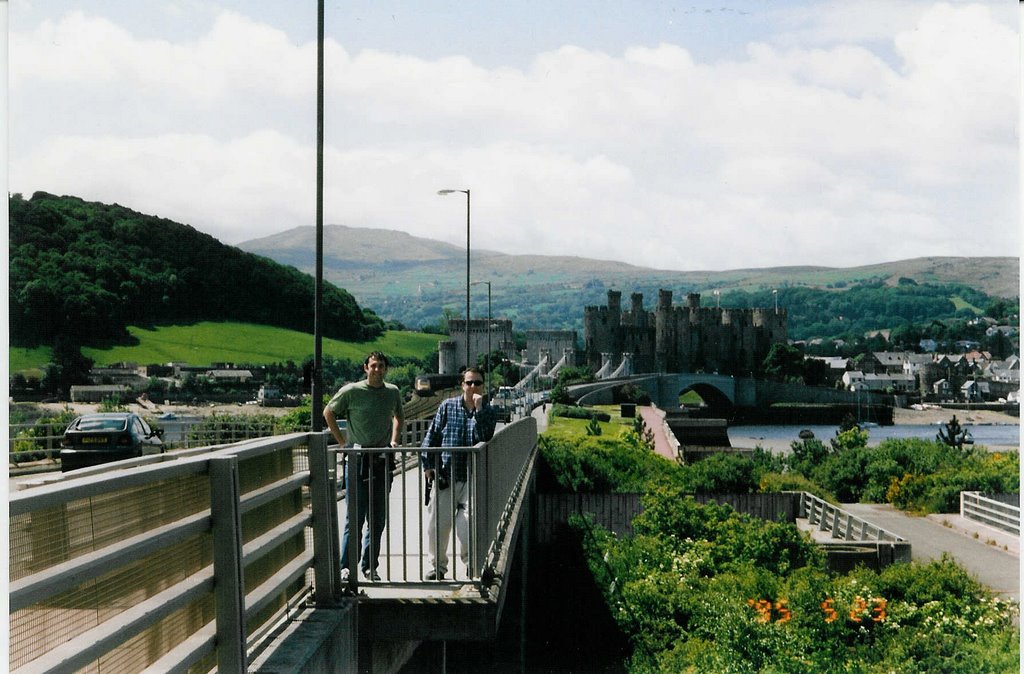
Castle Conwy, Wales

The picture is of a friend and I back in 2001.

The First Cause argument


Introduction

This is not a review of Aquinas’ cosmological argument, but a look at the related idea of first cause, using William Lane Craig’s kalam
[1] cosmological argument as a guide.

William Lane Craig

He presents the kalam cosmological argument.

1. Whatever begins to exist has a cause of its existence.
2. The universe began to exist.
2.1 Argument based on the impossibility of an actual infinite.
2.11 An actual infinite cannot exist.
2.12 An infinite temporal regress of events is an actual infinite.
2.13 Therefore, an infinite temporal regress of events cannot exist.
2.2 Argument based on the impossibility of the formation of an actual infinite by successive
addition.
2.21 A collection formed by successive addition cannot be actually infinite.
2.22 The temporal series of past events is a collection formed by successive addition.
2.23 Therefore, the temporal series of past events cannot be actually infinite.
3. Therefore, the universe has a cause of its existence.
[2]

1. Whatever begins to exist has a cause of its existence.

Randomness

Metaphysical intuition states that something cannot come out of nothing.
[3] Craig deduces that in regard to the universe, if there were originally nothing, including no God, the universe could not come into existence. However, with the existence of an eternal God, the creator could have brought about creation and matter ex nhilio (out of nothing).[4]

Victor Gijsbers in contrast states scientifically that many events in nature are random, including quantum
[5] processes. He notes that it is difficult to prove cause and effect.[6] For clarity, I wish to provide a scientific definition of randomness. Lawrence Sklar in The Cambridge Dictionary of Philosophy defines randomness within the philosophy of science. He describes the intuitive distinction between a sequence that is random and one that is orderly and how they play a role in the probability theory of dynamic systems.[7] Sklar also writes that there are subjectivist definitions of randomness which focus on the inability of an agent to determine, by knowledge, future occurrence in a sequence, and there are objectivist definitions of randomness which seek to describe it without reference to any agent.[8]

I am not a scientist, but philosophically speaking it seems reasonable to deduce that apparent randomness or disorder could occur within matter that has previously been caused in an orderly way. After a cause brings about the process that produces matter, apparent randomness and disorder could occur. However, it seems questionable and contradictory to state that initial randomness and disorder could lead to complex processes. I can see disorder occurring in material that was previously ordered, but it is much more difficult to deduce that matter in disorder can structure itself in any kind of complex form. 

For example, the human body has the appearance of being structured and ordered, but there can be apparently random events that take place within it, or corruption and disorder that takes place because of disease or injury. In contrast, I would deduce that a disordered mass of human material could never produce any actual person; there would always be a need for a cause and order for an actual human being to exist. Cause and effect seem a reasonable conclusion in regard to the existence of a complex material being, as matter and the universe seemingly require a cause to exist, and the effects can be seen in the development process, which could include certain events taking place which seem apparently random, but likely have some type of cause which may not as of yet been observed. 

A new born baby may have not been scientifically planned in a laboratory, but seemingly it has a genetic code that makes it specifically human so that it would not have likely developed by a random process from disorder. The order and structure of a new born baby assures that it will not be a new born ape, for example. However, within the genetic structure of a new born human being, there may very well be apparently random events that take place, or there may be planned events that are simply beyond complete human scientific comprehension.

Who created God?

An objection arises, who created God? Gijsbers states that even if the first cause argument is valid, then God would have to have a cause as well.
[9] However, many theists including myself, would disagree with this observation, because God would be viewed as infinite, and eternal, in contrast to matter, time and space which would be viewed as finite, and created. Peter Kreeft notes that the first cause argument does not use the premise that everything needs a cause, only that everything in motion, everything dependent needs a cause.[10] God would be viewed as infinite, eternal and immutable (unchangeable), and would not need a cause.

I would add that everything finite, needs a cause.

2. The universe began to exist.

2.1 Argument based on the impossibility of an actual infinite.
2.11 An actual infinite cannot exist.
2.12 An infinite temporal regress of events is an actual infinite.
2.13 Therefore, an infinite temporal regress of events cannot exist.
2.2 Argument based on the impossibility of the formation of actual infinite by successive addition.
2.21. A collection formed by successive addition cannot be actually infinite
2.22 The temporal series of past events is a collection formed by successive addition.
2.23 Therefore, the temporal series of past events cannot be actually infinite.

Infinite Regression

An actual infinite cannot exist because of the problem of infinite regression. I would deduce as others have, that if there was an infinite, limitless past, we would never have arrived at the present. Therefore 2.11 is correct, as we cannot have an actual infinite (past), nor can we have an infinite temporal regress as described in 2.12, because that would equal an actual infinite as Craig would put it. 2.13 is therefore reasonable and rather than reality consisting of an infinite past, it consists of a finite past that had a beginning.

Simon Blackburn points out a potential problem with deducing that each event requires a preceding event would mean that the first cause also requires a preceding event. Blackburn correctly states that the preceding natural events must be distinguished from an initial supernatural event to avoid this problem, the supernatural event would need no cause.
[11]

With 2.21, Craig notes that one cannot have an actual infinite collection of things by simple addition.[12] This means that a proposed infinite past could not be reached as the formation of an actual infinite would not be reached whether one proceeds to or from infinity.[13] The events described in 2.2 would therefore be finite and not infinite in agreement with 2.23.The Big Bang

Craig writes that scientifically the big bang theory seems to require that the universe began and was created out of nothing.
[14] By nothing, it is meant that it was not created by pre-existent matter.
Time and space would also be finite creations.

The following question is posed to a NASA Astrophysicist

The Question
(Submitted November 08, 1997)

What is the
big bang theory? What do you believe?

The Answer

'The big bang theory is the theory that the
universe started from a single point, and has been expanding ever since.

This has been well-established by observations, such as the apparent movement of
galaxies away from us, and the cosmic microwave background radiation believed to be the leftover light from the big bang.

The evidence for a big bang having taken place about 15 to 20 billion years ago is overwhelming, so I naturally believe that it is the case.

However, if your real question is "why did the big bang happen in the first place?" then that ceases to be an astronomical question, but a religious one.

Some astronomers, who are religious, argue that the big bang theory confirms the existence of God and the basic
elements of the creation story as told in the Bible. First came light, then the heavens, then the Earth ...

However, many other scientists do not. Scientists, like people in most any profession, have a vast diversity of religious beliefs. Some of us attend houses of worship, others do not. Some of us consider ourselves very religious, others consider ourselves staunch atheists. Just because we study astronomy does not mean we have any more agreement as to the “why'' questions than anyone else.

On the other hand, it is safe to say that as scientists we can agree on an approach to learning about nature and the universe. This approach is one of using observations to test theories. And when a theory has been tested as much as the big bang theory, with each test reconfirming its validity, then we believe that it likely true -- at least more true than those theories which have failed the observational tests.

Good luck on your quest for the truth.

Jonathan Keohane for Ask an Astrophysicist
[15]

There are many in the scientific community who believe in the big bang theory, so it is at least a reasonable theory for the theist to consider.

3. Therefore, the universe has a cause of its existence.'

The Christian God?

If the first cause argument is valid, does it prove the Christian God? No. I think that God needs to reveal himself supernaturally to be understood as a personal being. However, does the idea of a first cause seem to agree with the concept of God in the Bible? Yes, in general terms. God is shown in Genesis to have been a living reality before creation, and therefore can be deduced as existing before matter, time or space or anything that human beings can empirically measure. Perhaps angelic beings existed before the creation of matter, but the deduction is that at one point God created time and the angels as well. 

A critic could argue that in limitless eternity, there could be many Gods and there is no reason to believe in one God. However, I would think that the infinite/limitless nature of the first cause would mean that there would only be one God, since two or more limitless Gods would be a logical contradiction. I would state that a hypothetical infinite array of Gods that could have existed before time in an eternal state would far more likely actually be one infinite God of one substance. I have also read critics that suggest that God within the first cause argument could have been some type of creature and not the benevolent God of Christianity. 

Since physical matter, time and space has a beginning and is not eternal, I have great difficulty thinking it a reasonable possibility that the first cause was a unicorn, or horrific monster, rather than a non-physical being. As far as God’s benevolence, I think the primary evidence for his nature and character would come via revelation. In Scripture God is called the Alpha and Omega (Isaiah and Revelation), the beginning and the end, and this concept seems to be in line with that of first cause. The idea being God was present from the beginning of creation, and will be present forever.[16] However, as God is uncaused and necessary and of necessity; God as first cause, is by default the good. If anything is good, it would be that which is necessary, infinite and external.

[1] In Arabic tradition, speech or discourse used to discuss speculative theology.[2] Craig (1991)(2006: 2).[3] Craig (1991)(2006: 12).[4] Craig (1991)(2006: 12-13).[5] The fundamental unit of electromagnetic energy.[6] Gijsbers, Victor (2006: 1).[7] Sklar (1996: 615).[8] Sklar (1996: 615).[9] Gijsbers, Victor (2006: 1).[10] Kreeft, Peter (2006: 4).[11] Blackburn (1996: 140).[12] Craig (1991)(2006: 7).[13] Craig (1991)(2006: 7).[14] Craig (1991)(2006: 10).[15] Keohane (1997: 1).[16] Browning, W.R.F. (1997: 12).
---
Vicious Regress

(If there is an infinite distance between Vancouver and Calgary, one will never arrive in Calgary)

In the Oxford Dictionary of Philosophy, Simon Blackburn discusses ‘infinite regress’ and mentions that this occurs in a vicious way whenever a problem tries to solve itself and yet remains with the same problem it had previously. Blackburn (1996: 324) A vicious regress is an infinite regress that does not solve its own problem, while a benign regress is an infinite regress that does not fail to solve its own problem. Blackburn (1996: 324). Blackburn writes that there is frequently room for debate on what is a vicious regress or benign regress. Blackburn (1996: 324).

Bradley mentions that a vicious regress is not illogical, and that it is not vicious regress to state that each act of free choice is caused by another act of free choice. I agree that it is not necessarily illogical, but disagree that the argument as described is not a vicious regress.

BLACKBURN, S. (1996) 'First Cause Argument', in Oxford Dictionary of Philosophy, Oxford, Oxford University Press.

BLACKBURN, S. (1996) ‘Regress’, in Oxford Dictionary of Philosophy, Oxford, Oxford University Press. 

BRADLEY, RAYMOND D. (1996) ‘Infinite Regress Argument’, in Robert Audi, (ed.), The Cambridge Dictionary of Philosophy, Cambridge, Cambridge University Press.

BROWNING, W. R. F. (1997) 'Alpha', in Oxford Dictionary of The Bible, Oxford, Oxford University Press.

CONWAY DAVID A. AND RONALD MUNSON (1997) The Elements of Reasoning, Wadsworth Publishing Company, New York.

CRAIG, WILLIAM LANE, (1991)(2006) ‘The Existence of God and the Beginning of the Universe’,Truth: A Journal of Modern Thought 3 (1991) 85-96. 
pp. 1-18.

GIJSBERS, VICTOR, (2006) ‘Theistic Arguments: First Cause’
http://positiveatheism.org/faq/firstcause.htm
pp. 1-2.

KEOHANE, JONATHAN, (1997) ‘Big Bang Theory’
http://imagine.gsfc.nasa.gov/docs/ask_astro/answers/971108a.html
p. 1.

KREEFT, PETER, (2006) ‘The First Cause Argument’ excerpted from Fundamentals of Faith.
http://catholiceducation.org/articles/apologetics/ap0168.html
pp. 1-5.

SKLAR, LAWRENCE, (1996) ‘Philosophy of Science’, in Robert Audi, (ed), The Cambridge Dictionary of Philosophy, Cambridge, Cambridge University Press.

Thursday, December 07, 2017

A Vicious Regress V: Intelligences

Facebook/Google+


A Vicious Regress V: Intelligences

The second video is long, but very informative.

The first video is shorter.  Latter-day Saint theology, in his scholarly and informed opinion holds that intelligences and matter are alone eternal.

However, nearer to the end of the first video, Dr. White states (paraphrased) that some Mormon apologists postulate that an infinite number of gods, exist. Based on the implication earlier in the video of the law of eternal progression, this law does connect to a concept of infinite gods.

I am not expert on The Church of Jesus-Christ Latter-day Saints, but having studied the nature of God within my United Kingdom MPhil/PhD studies (1999-2010 and prior in British Columbia) with theodicy, the problem of evil, free will and determinism, I do have some significant expertise in regard to the nature of God, philosophically and theologically.

In my opinion, an infinite number of gods, would reasonably require an infinity to eternally progress. How could there be an eternal progression of gods in a finite amount of time (Not necessarily solar time, but the point stands)?

Therefore, for those Latter-day Saints apologists that hold to the existence of an infinite number of gods, it is more reasonable that this an aspect of the infinite and eternal, as opposed to the finite.

But, if this occurred in an infinite timeless state, in my view this would rule out any concept of progression; these infinite gods would simply be infinite gods. There is no progression from point a to point b.

There is the problem of more than one infinite entity. Reasonably, only one infinite, limitless being could exist.

Further

This would fall into the category of vicious regress. Contrasted with a reasonable view of the Trinitarian God which as infinite and eternal 'Is'. There is no progression and no regress or progress.

Cited from my archives

LDS Temple April 2010

Vicious Regress October 2006

Matthew J. Slick notes that the Latter-day Saints' idea of Gods, which originated with Joseph Smith, teaches an infinite regression of causes. Slick (2006: 1). Each God came into existence from a previous God, and this has gone on in an infinite past. Slick (2006: 1). There cannot be an infinite regression of Gods because this would require an infinite amount of time which would not allow us to arrive at the present.

In contrast the idea of the Christian Trinity is that God has always existed and existed prior to time and therefore God has not lived for an infinite amount of time. God created time, but existed in a timeless state prior to the creation of time, space and matter.

In the Oxford Dictionary of Philosophy, Simon Blackburn discusses ‘infinite regress’ and mentions that this occurs in a vicious way whenever a problem tries to solve itself and yet remains with the same problem it had previously. Blackburn (1996: 324). A vicious regress is an infinite regress that does not solve its own problem, while a benign regress is an infinite regress that does not fail to solve its own problem. Blackburn (1996: 324). Blackburn writes that there is frequently room for debate on what is a vicious regress or benign regress. Blackburn (1996: 324).

In The Cambridge Dictionary of Philosophy, William Tolhurst writes that a vicious regress is in some way unacceptable as it would include an infinite series of items dependent on prior items. A vicious regress may be impossible to hold to philosophically, or it may be inconsistent. Tolhurst (1996: 835). 

BLACKBURN, S. (1996) ‘Regress’, in Oxford Dictionary of Philosophy, Oxford, Oxford University Press.

SLICK, MATTHEW J. (2006) 'A logical proof that Mormonism is false', Meridian, Idaho, Christian Apologetics and Research Ministry, http://www.carm.org/lds/infinity.htm

SMITH, JOSEPH (1844)(2006) ‘Sermon by the Prophet-The Christian Godhead-Plurality of Gods’, History of the Church, Vol. 6, p. 473-479. http://www.utlm.org TOLHURST,

TOLHURST, WILLIAM (1996) 'Vicious Regress', in Robert Audi, (ed.), The Cambridge Dictionary of Philosophy, Cambridge, Cambridge University Press.

Monday, October 02, 2006

A Vicious Regress

A Vicious Regress

2006 article, reformatted and edited on August 1, 2022.

Photos: McSween, BC (trekearth)

Introduction

The concept of infinite regression has been discussed in two of my previous articles, but I wanted to deal with the topic primarily in this posting.

In the Oxford Dictionary of Philosophy, Simon Blackburn discusses ‘infinite regress’ and mentions that this occurs in a vicious way whenever a problem tries to solve itself and yet remains with the same problem it had previously.[1] A vicious regress is an infinite regress that does not solve its own problem, while a benign regress is an infinite regress that does not fail to solve its own problem.[2] Blackburn writes that there is frequently room for debate on what is a vicious regress or benign regress.[3]

In The Cambridge Dictionary of Philosophy, William Tolhurst writes that a vicious regress is in some way unacceptable as it would include an infinite series of items dependent on prior items.[4] A vicious regress may be impossible to hold to philosophically, or it may be inconsistent.[5] From the same volume, Raymond D. Bradley cautions that the mere existence of an infinite series is not the same as infinite regression, and is not philosophically objectionable.[6] His first example is that every natural number (a positive integer, 1,2,3,4, …, or a non-negative integer, 0,1,2,3,4,…) has a successor that is a natural number.[7] Bradley writes that it would not be illogical to state that each free act of consequence is a result of an act of free choice.[8] Bradley thinks that trying to answer infinite regress by bringing in the idea of the theist’s God makes no sense.[9]

As usual, Blackburn offers reasonable and helpful definitions and explanations. I also find Tolhurst’s ideas helpful. I agree with Bradley that an infinite series of numbers is not objectionable or a vicious regress. I do not doubt that we can hypothetically at least, count from 0 or 1 to infinity, but we are dealing with hypothetical numbers, and not actual things. Numbers are members or sets used to describe real things. For example, I could say I have 200 compact discs but it would be the compact discs that are actual things and not the number 200.

Edwards and Free Choice

Bradley mentions that it is not illogical, and not a vicious regress that each act of free choice is caused by another act of free choice. Jonathan Edwards deals with this issue in a previous blog article I wrote entitled, Jonathan Edwards and Libertarian Free Will. Again, for philosophical clarity, in my view choices are real things, not members or sets like numbers used to describe real things.

Thursday, August 31, 2006 Jonathan Edwards and Libertarian Free Will

Edwards thinks that if the human will determines the will and resulting choices, and since every choice must have a cause, then a chain is established where a will and choice is determined by a preceding will and choice. Therefore, if the will determines its own free acts, then every free act of will and choice is determined by a preceding act of will and choice. If a preceding act of will also be of free choice, then that too was self-determined. What Edwards is stating is that in the act of causing a free choice (choice1), the cause of that choice was also made freely (choice2), and the cause of that choice was made freely (choice3) and so on.[10] This would be a vicious regress since it could not be determined what caused human choice initially, because every free choice was caused by a previous free choice. Edwards instead believed that human choices were a result of human nature originally created by God’s will. This human nature had become corrupted and as a result human beings desired and had motivation to do sinful acts only that were not pleasing to God.

A possible way out of this contradiction is to come to the last act of will and choice and state that it is not self-determined, but is rather determined without the use of a will and choice. However, to Edwards, if the initial act of will and choice within the chain is not free, then none of the resulting willed choices can be free.[11] By stating that acts of the will occur without any cause at all is to render human choice random, and if human choices are made randomly it is difficult to establish any ethical value to them.

The following is my speculative chain, influenced by Edward’s idea of how the human will works:

God would freely and by choice give human beings within their nature consciousness and self-awareness, an understanding that they have identity as an individual. There would be in a sense significant, yet limited freedom present within the human consciousness to have an understanding of personal identity, apart from every other individual entity, but this in itself would not be free will or choice, and would not be libertarian free will.[12] Human choice would be caused by the human nature which has consciousness and from that motives and desires. Human nature and consciousness does not choose to be as it is, but was created by God, and has been corrupt since the fall of humanity. From consciousness and self-awareness, human beings would develop motives and desires, and eventually make limited free will choices. This a reasonable explanation that does not use a vicious regress in trying to explain that every human choice made through libertarian free will is made by a previous choice, and so on. It must be noted that God would be the primary cause of human actions, while human beings (and angelic beings at times) would be the secondary cause of human actions. The concept of human beings as a secondary cause of actions is essential to the idea of compatibilism or soft determinism.

Craig and the First Cause

In The First Cause argument article on this blog I discussed William Lane Craig’s understanding of first cause.

He presents the kalam cosmological argument.

1. Whatever begins to exist has a cause of its existence.
2. The universe began to exist.
2.1 Argument based on the impossibility of an actual infinite.
2.11 An actual infinite cannot exist.
2.12 An infinite temporal regress of events is an actual infinite.
2.13 Therefore, an infinite temporal regress of events cannot exist.
2.2 Argument based on the impossibility of the formation of an actual infinite by successiveaddition.
2.21 A collection formed by successive addition cannot be actually infinite.
2.22 The temporal series of past events is a collection formed by successive addition.
2.23 Therefore, the temporal series of past events cannot be actually infinite.
3. Therefore, the universe has a cause of its existence.[13]

Premise 1 deduces that something cannot come from nothing, and that the material universe is not self-caused.[14] Premise 2 therefore states that the universe began and 2.1 deduces that the actual infinite is impossible. An actual infinite cannot exist because if there was an infinite, limitless past, we would never have arrived at the present. Therefore 2.11 is correct, as we cannot have an actual infinite (past), nor can we have an infinite temporal regress as described in 2.12, because that would equal an actual infinite as Craig would put it. 2.13 is therefore reasonable and rather than reality consisting of an infinite past, it consists of a finite past that had a beginning.

With 2.21, Craig notes that one cannot have an actual infinite collection of things by simple addition. This means that a proposed infinite past could not be reached as the formation of an actual infinite would not be reached whether one proceeds to or from infinity.[15] The events described in 2.2 would therefore be finite and not infinite in agreement with 2.23. Premise 3 concludes that the universe has a cause.

If matter and the universe is eternal and therefore unlimited in time, I have not read a convincing explanation that explains how we could arrive at our present state, and indeed have a future. From the first cause argument I would deduce that the universe has a cause and this cause is an infinite, omnipotent being who has always existed beyond time and matter, and created time and matter. I realize that for the finite human mind this type of creator or God cannot be completely comprehended, only apprehended to a point, but it seems that the idea of first cause is not contradictory where as a vicious regress associated with an infinite temporal regress of events is very problematic because neither the present or future would be realized because of an unlimited past.

Joseph Smith and Gods

Joseph Smith the founder of The Church of Jesus Christ of Latter-day Saints writes that there is a plurality of gods. Please note, this is not an attack against the Church, or the people within it, but simply a review of a theological point. I am not interested in attacking in a militant fashion any religious or philosophical group. I am focused on reviewing ideas in order to grow in my understanding and to perhaps help others in an understanding of the Biblical God. I think the topics I discuss are already controversial enough and so there is no need to be militant as well! However, I firmly believe in taking a stand for the truth.

Smith preached on June 16,1844, eleven days before his death, that a plurality of Gods existed and that the head God organized the heavens and the earth.[16] Smith explains that the idea of the God of the Christian Trinity is a strange one.[17] He also states that the Bible supports the idea of the plurality of Gods.[18] The founder of the Latter-day Saints reasons that if Jesus Christ had a Father, that God the Father would have a Father as well. This concept would create an infinite regression of Father Gods.[19] This established a vicious regress within the Latter-day Saints theology concerning God.

The Walter Martin website has some interesting comments on this view. Martin first points out that the Bible in Isaiah, clearly states that there is just one God in Chapters 43:10-11, 44:6, 8; 45:5, and 21–22.[20] Martin also mentions that the Lord is called one Lord in Deuteronomy 6:4.[21] Martin further explains that others are called god in the Bible such as Moses to Pharaoh in Exodus 7:1, but this is a metaphorical use and is not claiming that Moses is the one and only true God.[22] In Psalm 82 and John 10:34, the judges according to Martin are not intrinsic deity, but became mighty ones like Gods in the eyes of the people. In Psalm 82 and John 10:34 the judges are shown to be sinful men that were in no way to be confused with the God of the Bible in nature.[23] The Bible in both the Hebrew Bible and New Testament is not only stating that there is only one true God to worship, but that there is only one God in existence period.

I am not going to heavily discuss Trinitarian theology within this article, but I shall state that it is believed within Christianity that the Father, Son, and Holy Spirit are three distinct persons of one, substance, nature and essence, and therefore are not three eternal Gods, but one eternal God. In Hebrews 1:3, the Son is called the exact representation of God’s nature, and in Acts 5:3-4 the Holy Spirit is called God. Philip Edgcume Hughes writes that in Hebrews 1:3, the Greek word translated “nature” denotes the very essence of God. Christ is the representation of the Father and shares the same substance as God.[24] So whatever distinctions can be drawn concerning the Father and Son, Biblically it must be concluded that from Hebrews 1:3 they are of the same nature (υποστασεως )[25] and substance. They are not two Gods, but two distinctions within one God, and the Holy Spirit from Acts 5 is also shown to be God sharing in the same nature and substance as the Father and Son. Jesus Christ as both God and man has a human body, but shares the same spiritual substance as the Father and Holy Spirit.

Matthew J. Slick notes that the Latter-day Saints' idea of Gods, which originated with Joseph Smith, teaches an infinite regression of causes.[26] Each God came into existence from a previous God, and this has gone on in an infinite past.[27] There cannot be an infinite regression of Gods because this would require an infinite amount of time which would not allow us to arrive at the present. In contrast the idea of the Christian Trinity is that God has always existed and existed prior to time and therefore God has not lived for an infinite amount of time. God created time, but existed in a timeless state prior to the creation of time and matter. Mary Kochan mentions the same problem with the Latter-day Saints' concept and states that with an infinite regression of Gods there is no way to get to the present and that time had to have a beginning in order for the present to exist.[28]

It appears the Smith’s notion of a plurality of Gods influenced the Latter-day Saints' theology which leads to infinite regression, but it is a contradictory view that features a vicious regress.

[1] Blackburn (1996: 324).[2] Blackburn (1996: 324).[3] Blackburn (1996: 324).[4] Tolhurst (1996: 835).[5] Tolhurst (1996: 835).[6] Bradley (1996: 371).[7] Bradley (1996: 371).[8] Bradley (1996: 371).[9] Bradley (1996: 372).[10] Edwards (1754)(2006: 2.1: 1-2).[11] Edwards (1754)(2006: 2.1: 2).[12] Libertarian free will is the idea that a person is able to perform another action in the place of one that has been committed. This action cannot be predetermined by any circumstance or desire.[13] Craig (1991)(2006: 2).[14] Craig (1991)(2006: 12).[15] Craig (1991)(2006: 7).[16] Smith (1844)(2006: 1).[17] Smith (1844)(2006: 1).[18] Smith (1844)(2006: 1).[19] Smith (1844)(2006: 1).[20] Martin (2006: 1).[21] Martin (2006: 1).[22] Martin (2006: 1).[23] Martin (2006: 1).[24] Hughes (1990: 43-44).[25] The Greek New Testament (1993: 741).[26] Slick (2006: 1).[27] Slick (2006: 1).[28] Kochan (2002: 1).
---

BLACKBURN, SIMON (1996) 'First Cause Argument', in Oxford Dictionary of Philosophy, Oxford, Oxford University Press. 

BLACKBURN, SIMON (1996) ‘Reductio ad Absurdum’, in Oxford Dictionary of Philosophy, Oxford, Oxford University Press. 

BLACKBURN, SIMON (1996) ‘Regress’, in Oxford Dictionary of Philosophy, Oxford, Oxford University Press.

BOWMAN, ROBERT M. (1990) Why You Should Believe in the Trinity, Grand Rapids, Baker Book House. 

BRADLEY, RAYMOND D. (1996) ‘Infinite Regress Argument’, in Robert Audi, (ed.), The Cambridge Dictionary of Philosophy, Cambridge, Cambridge University Press.

BROWNING, W. R. F. (1997) 'Alpha', in Oxford Dictionary of The Bible, Oxford, Oxford University Press.

CONWAY DAVID A. AND RONALD MUNSON (1997) The Elements of Reasoning, Wadsworth Publishing Company, New York.

CRAIG, WILLIAM LANE, (1991)(2006) ‘The Existence of God and the Beginning of the Universe’,Truth: A Journal of Modern Thought 3 (1991) 85-96.

http://www.leaderu.com/truth/3truth11.html
pp. 1-18.

CRANFIELD, C.E.B. (1992) Romans: A Shorter Commentary, Grand Rapids, William B. Eerdmans Publishing Company. 

EDWARDS, JONATHAN (1729)(2006) Sovereignty of God, New Haven, Connecticut, Jonathan Edwards Center, Yale University. http://edwards.yale.edu/archive/documents/page?document_id=10817&search_id=&source_type=edited&pagenumber=1 

EDWARDS, JONATHAN (1731-1733)(2006) Law of Nature, New Haven, Connecticut, Jonathan Edwards Center, Yale University.

EDWARDS, JONATHAN (1754)(2006) Freedom of the Will, Flower Mound, Texas.http://www.jonathanedwards.com

ERICKSON, MILLARD (1994) Christian Theology, Grand Rapids, Baker Book House. 

ERICKSON, MILLARD (2003) What Does God Know and When Does He Know It?, Grand Rapids, Zondervan.

FRANKE, JOHN R. (2005) The Character of Theology, Baker Academic, Grand Rapids. 

FEINBERG, JOHN S. (1994) The Many Faces of Evil, Grand Rapids, Zondervan Publishing House.

FOULKES, FRANCIS (1989) Ephesians, Grand Rapids, Inter-Varsity Press.

GEISLER, N.L. (1996) ‘Freedom, Free Will, and Determinism’ in Walter A. Elwell (ed.), Evangelical Dictionary of Theology, Grand Rapids, Baker Books. 

GRENZ, STANLEY J., DAVID GURETZKI and CHERITH FEE NORDLING (1999) Pocket Dictionary of Theological Terms, Downers Grove, Ill., InterVarsity Press.

GIJSBERS, VICTOR, (2006) ‘Theistic Arguments: First Cause’http://positiveatheism.org/faq/firstcause.htm pp. 1-2. 

HUGHES, P. E. (1990) A Commentary On The Epistle To The Hebrews, Grand Rapids, William B. Eerdmans Publishing Company.

HUGHES, P. E. (1996) ‘Grace’ in Walter A. Elwell (ed.), Evangelical Dictionary of Theology, Grand Rapids, Baker Books. 

KEOHANE, JONATHAN, (1997) ‘Big Bang Theory’ http://imagine.gsfc.nasa.gov/docs/ask_astro/answers/971108a.html p. 1.

KOCHAN, MARY (2002) 'Drawing the Line for Mormons - A Closer Look at the LDS Church', Powell River, B.C., Catholic Information Resource Center. 
http://www.catholiceducation.org/articles/apologetics/ap0112.html

KREEFT, PETER, (2006) ‘The First Cause Argument’ excerpted from Fundamentals of Faith  http://catholiceducation.org/articles/apologetics/ap0168.html pp. 1-5.

LANGER, SUSANNE K (1953)(1967) An Introduction to Symbolic Logic, Dover Publications, New York. (Philosophy).

MARTIN, WALTER (2006) 'The Mormon Doctrine of God', San Juan Capistrano, Walter Martin.org. 
http://www.waltermartin.org/mormon.html#mormdoc

MOUNCE, R.H. (1990) The Book of Revelation, Grand Rapids, William B. Eerdmans Publishing Company.

MOUNCE, R.H. (1995) The New American Commentary: Romans, Nashville, Broadman & Holman Publishers.

PIRIE, MADSEN (2006)(2015) How To Win Every Argument, Bloomsbury, London.

POJMAN, LOUIS P. (1996) Philosophy: The Quest for Truth, New York, Wadsworth Publishing Company.

REED, HOLLY (2004) ‘Jonathan Edwards’, in The Boston Collaborative Encyclopedia of Modern Western Theology, Boston, The Boston Collaborative Encyclopedia of Modern Western Theology

SCHRECK, ALAN (1984) Catholic and Christian, Ann Arbor, Michigan, Servant Books.

SKLAR, LAWRENCE, (1996) ‘Philosophy of Science’, in Robert Audi, (ed), The Cambridge Dictionary of Philosophy, Cambridge, Cambridge University Press.

SLICK, MATTHEW J. (2006) A logical proof that Mormonism is false, Meridian, Idaho, Christian Apologetics and Research Ministry. http://www.carm.org/lds/infinity.htm

SMITH, JOSEPH (1844)(2006) ‘Sermon by the Prophet-The Christian Godhead-Plurality of Gods’, History of the Church, Vol. 6, p. 473-479. 
http://www.utlm.org

STORMS, SAM (2006) 'Jonathan Edwards on the Will', Kansas City, Missouri. Enjoying God Ministries. Enjoyinggodministries.com http://www.enjoyinggodministries.com/article.asp?id=368 

TCHIVIDJIAN, W. TULLIAN, (2001) ‘Reflections on Jonathan Edwards’ View of Free Will, in IIIM Magazine Online, Volume 3, Number 51, December 17 to December 23, Fern Park, Florida, IIIM Magazine Online.

THE GREEK NEW TESTAMENT (1993), Munster, Deutsche Bibelgesellschaft, United Bible Societies.

THIESSEN, HENRY C. (1956) Introductory Lectures in Systematic Theology, Grand Rapids, Wm. B. Eerdmans Publishing Company.

TOLHURST, WILLIAM (1996) 'Vicious Regress', in Robert Audi, (ed.), The Cambridge Dictionary of Philosophy, Cambridge, Cambridge University Press.

Saturday, December 30, 2023

The unfixed (PhD Edit)

The unfixed (PhD Edit)

1 Preface

Originally published article on 2019/06/14 and revised 2023/12/30. The original website version was very short, so I also republished the new version on Blogger, 2023/12/30.

From

2010 Theodicy and Practical Theology: PhD thesis, the University of Wales, Trinity Saint David, Lampeter 

Saturday, September 19, 2020: PhD Full Version PDF: Theodicy and Practical Theology 2010, Wales TSD

The unlimited and unfixed. Blackburn (1996: 193). God is considered infinite and his creation finite and therefore limited.
---

2 The Unfixed: December 30, 2023

In the Blackburn text within his entry, infinity, it defines infinity as 'The unlimited which goes beyond any fixed bound.' (193). Theologically and philosophically, I view God as unfixed, but this unfixed nature (ontological nature) would exist within logic. God is not by nature, illogical and contradictory. For example, God could not stop being God, or make another equal, infinite, eternal God.

Referencing my PhD and website work:

John Frame explains that God cannot perform logically contradictory actions, Frame (2002: 518). Erickson (1994: 277). Shedd (1874-1890)(1980: 359-360 Volume 1). God cannot make a square circle, Frame (2002: 518). Thiessen (1956: 126). God cannot commit that which is immoral and sinful, Frame (2002: 518). Thiessen (1956: 126). Weber (1955)(1981: 440). Interestingly, God cannot commit actions ‘appropriate only to finite creatures.’ Frame (2002: 520). 

God cannot logically have finite attributes. All of God's attributes and nature are infinite. In the incarnation, God the Son takes a finite human nature, as Jesus Christ, while remaining the eternal, infinite God. But the infinite and finite natures do not mix. God the Son, as infinite, within the Trinity, did (does) take a finite, human nature in the incarnation. Correctly, and classically, the natures do not mix. Jesus Christ is both finite man and infinite God. There is an aspect of mystery in the incarnation, but the Triune nature of God which is infinite and eternal is not altered by Christ taking on additional finite human nature. According to the Pocket Dictionary, the hypostatic union is the theological term which describes the bringing together of the divine and human natures of Jesus Christ is one person. (62). God the Son, Jesus Christ, being both fully human and fully divine. (62). Hypostasis (ὑπόστασις) from the Greek in this context, is the essential nature and essence of a person/entity.

Jesus Christ remains fully, infinitely, divine and fully, finitely, human, forever as the King that will one day return to fully culminate the Kingdom of God:

Acts 1: 9-11 

New American Standard Bible: NASB 

9 And after He had said these things, He was lifted up while they were watching, and a cloud took Him up, out of their sight. 10 And as they were gazing intently into the sky while He was going, then behold, two men in white clothing stood beside them, 11 and they said, “Men of Galilee, why do you stand looking into the sky? This Jesus, who has been taken up from you into heaven, will come in the same way as you have watched Him go into heaven.”


3 Symbolic Logic

LANGER, SUSANNE K (1953)(1967) An Introduction to Symbolic Logic, Dover Publications, New York. 

Langer: Key symbols 

≡df = Equivalence by definition 
: = Equal (s) 
ε = Epsilon and means is 
⊃ = Is the same as
⊨ is Entails 
˜ = Not 
∃ = There exists 
∃! = There exists 
∴ = Therefore 
. = Therefore 
< = Is included 
v = a logical inclusive disjunction (disjunction is the relationship between two distinct alternatives)
x = variable 
. = Conjunction meaning And 
0 = Null class 
cls = Class 
int = Interpretation

My philosophical example based on reviewing the Langer text: The infinite class (God) is simply infinite, nothing can be multiplied or added to that class. The finite class is simply finite, nothing can be multiplied or added to that class.   

i = infinite
f = finite 

i ˜ ⊃ f 

The infinite is not the same as the finite. 

i ˜ ⊨ f 

The infinite does not entail the finite. 

And I add: 

i . ˜ f 

The infinite is therefore, not the finite. 

i : ˜ f 

The infinite equals not, the finite. 

(∃! i) + (∃! f) ˜ :

There exists the infinite, plus there exists the finite, they are not equal.

BLACKBURN, SIMON (1996) Oxford Dictionary of Philosophy, Oxford, Oxford University Press.

CONWAY DAVID A. AND RONALD MUNSON (1997) The Elements of Reasoning, Wadsworth Publishing Company, New York. 

ERICKSON, MILLARD (1994) Christian Theology, Grand Rapids, Baker Book House. 

ERICKSON, MILLARD (2003) What Does God Know and When Does He Know It?, Grand Rapids, Zondervan.

FRAME, JOHN M. (1999) ‘The Bible on the Problem of Evil: Insights from Romans 3:1-8,21-26; 5:1-5; 8:28-39’, IIIM Magazine Online, Volume 1, Number 33, October 11 to October 17, Fern Park, Florida, Third Millennium. 

FRAME, JOHN M. (2002) The Doctrine of God, P and R Publishing, Phillipsburg, New Jersey.

GRENZ, STANLEY J., DAVID GURETZKI and CHERITH FEE NORDLING (1999) Pocket Dictionary of Theological Terms, Downers Grove, Ill., InterVarsity Press. 

LANGER, SUSANNE K (1953)(1967) An Introduction to Symbolic Logic, Dover Publications, New York. 

PHILLIPS, D.Z. (1981) Encountering Evil, Stephen T. Davis (ed.), Atlanta, John Knox Press.

PHILLIPS, D.Z. (2005) The Problem of Evil and the Problem of God, Fortress Press, Minneapolis.

PIRIE, MADSEN (2006)(2015) How To Win Every Argument, Bloomsbury, London.
 
SHEDD, WILLIAM G.T. (1874-1890)(1980) Dogmatic Theology, Volume 1, Nashville, Thomas Nelson Publishers. 

SHEDD, WILLIAM G.T. (1874-1890)(1980) Dogmatic Theology, Volume 2, Nashville, Thomas Nelson Publishers. 

THIESSEN, HENRY C. (1956) Introductory Lectures in Systematic Theology, Grand Rapids, Wm. B. Eerdmans Publishing Company. 

WEBER, OTTO (1955)(1981) Foundations of Dogmatics, Volumes 1 and 2, Translated and annotated by Darrell L. Guder, William B. Eerdmans Publishing Company.

Thursday, August 02, 2012

Infinite Versus Finite (God, Creation)

Infinite Versus Finite (God, Creation)

Preface

Chateau near Paris, France (trekearth)

I have taken material from previous posts 'Infinite' and 'Infinite Revisited' edited some material and added some in for more of the 'finite' angle to be included.

Infinite Versus Finite (God, Creation)

Philosopher Blackburn explains that the infinite is unlimited and that which is beyond anything that is fixed and bound. Blackburn (1996: 193). In contrast a ‘finite set’ (example used) is a set that stops at a point, somewhere. Blackburn (1996: 140). Brian Davies writes that the English word infinity comes from the Latin word ‘infinitas’, meaning boundless or endless. Davies (1999: 298). Davies states that some have ascribed the term infinity with various degrees of understanding of substance, time, space, the universe, numbers, and classes. Davies (1999: 298). He mentions that many philosophers have dealt with the issue of infinity through the centuries, but Biblically speaking there is not a doctrine of infinity. Davies (1999: 298). Biblically there is not a specific philosophical explanation of a doctrine of the infinite God. He explains that God's infinity is viewed as marking his perfection, and that God alone is understood as infinite. Davies (1999: 298). As one could count to the minus and to the plus to infinity, numbers could be considered infinite in a sense, but are not ontological living beings. As God is uncreated and uncreatable, he is alone is infinite ontologically. God would not be limited by time and space, and so in another sense created matter and space would be considered finite and not infinite within traditional Christian thought. God would be superior to all creatures and would be omniscient, omnipotent, omnipresent, and eternal. Davies (1999: 298). Davies notes that process theology has postulated that God's personal nature means that he can change as he works within created time. Davies (1999: 228). Process theology reasons that God possibly develops in personality as he deals with his created beings. Davies (1999: 228).

It could be stated that if God's nature can be changed and develop within time, then he is not infinite, but rather the most advanced finite being in existence. A finite being that is beyond matter, space and time, perhaps. I reject process theology's notion of a finite God, for at least the following reasons.

It could be argued that if God is not infinite then he cannot posses any infinite attributes, and this would prohibit God from being eternal. To be eternal would mean that one has unlimited life. If God is not eternal, then how did God come to exist? If there was a God that created God and so on, there is the problem of vicious regress in which there are a hypothetical infinite regressions of Gods. If it is suggested at some point the regression ends, why cannot one simply reject the vicious regress and state that the Biblical God, or a God, is the only God? To state that God simply came to exist from nothing does not seem reasonable, and the suggestion answers nothing. If God is merely finite, then one has a problem of determining the first cause. A reasonable explanation is that God prior to time eternally was and eternally is today.

Many scientists and scholars reason that the universe is 15-20 billion years old, and believe in a 'Big Bang Theory'. Whether the universe is billions, millions, or thousands of years is not the primary concern of this article, but with a big bang model or like, the universe in agreement with the Bible, is not eternal. Billions, millions, or thousands of years is more time than any of human being, only living 100+ years maximum in the modern age can comprehend and may be considered perhaps from a human perspective, virtual eternity, but is not actual eternity, and therefore is not infinite. Since God created matter, time and space in Genesis, Chapter 1, it is clear that nothing within the material, physical realm existed prior to creation. This would leave God, and perhaps the angelic beings prior to the existence of matter, time (solar time at least) and space. It can be deduced that angels cannot be infinite in nature, because if they were limitless in nature they would themselves be God. It can be reasoned there are two or more limitless beings by definition as they simply would be an aspect of one infinite, eternal God of one substance. Thiessen notes angels are not eternal although the Bible does not state when they were created. Thiessen (1956: 191).

Thiessen thinks angels may have been formed at the Genesis 1 creation or just after. Thiessen (1956: 191). I would of course have no definite idea, but think that angels were created within some type of time, not solar time. I do not reason that angels existed in a timeless state with God. I would deduce that even non-physical finite spiritual beings must exist within time, although not necessarily within physical matter, time and space, in order to process thought patterns, as God alone is all-knowing and does not need to process thoughts within time. I would conclude this point by stating that God alone existed before the creation of matter, time and space and angelic beings. Again, God eternally simply was and is.

I suppose it possible and perhaps reasonable for God to instantaneously provide angelic beings with information in a timeless state, and at the same time  I deduce information would also have to be available for demonic beings in the spiritual realm if time does not exist there, in order for them to function as the Bible has them. I am not meaning solar time, but time allotted for a finite spiritual being to process thoughts. For example, angels to process instructions from God and communicate and for demonic beings to communicate.

I reason a timeless state is more difficult philosophically as in likely being correct than a spiritual realm of some sort with time where angels and demons would work.

Millard J. Erickson discusses the Scriptural concept of God's existence in contrast to that of his creation. In Acts 17: 24-25 it states that God does not dwell physically, but is the creator of everything. Erickson notes that God is called the first and last in Isaiah 44: 6, and the Alpha and Omega in Revelation 1:8, 21:6, and 22:13. The idea being shown here is that God has always existed and will always exist. Erickson (1994: 273-274).

As pointed out previously, before the creation of matter and the angels nothing else would have existed. There is also the idea put across in Scripture that God is immutable and does not change in his nature. Malachi 3:6 states that the Lord does not change and Erickson views this as referring to God’s nature and attributes.

God and not his creation, is alone infinite in the sense described.

Human beings in contrast are finite. Humanity has a distinct Biblical religious historical beginning in Genesis 1-2, and a secular historical beginning which is not certain as far as date. From a Biblical perspective, even with promises of everlasting life for those in Christ a human being that lives forever with a resurrected body is still finite ontologically.

Any other living creatures that would exist in the new creation described in Revelation would also be finite.

BLACKBURN, SIMON (1996) Oxford Dictionary of Philosophy, Oxford, Oxford University Press.

DAVIES, BRIAN (1999) ‘Infinity’, in Alan Richardson and John Bowden (eds.), A New Dictionary of Christian Theology, Kent, SCM Press Ltd.

ERICKSON, MILLARD (1994) Christian Theology, Grand Rapids, Baker Book House.

THIESSEN, HENRY C. (1956) Introductory Lectures in Systematic Theology, Grand Rapids, Wm. B. Eerdmans Publishing Company.


Hohenaschau Castle, Germany (trekearth)


Royal Palace, Madrid (trekearth)


Glasgow (trekearth)

Friday, March 29, 2024

Vicious sports regress

January 16, 2017
Vicious sports regress

Preface

This posting was published January 16, 2017, and was revised March 29, 2024. 

Some related articles


Prime Time Sports 

This was hosted by Bob McCown on Sportsnet at the time. (Paraphrased conversation)

Prime Time

Caller: The baseball player mentioned, signed with a new agent. But how did he find that agent? Did he not need an agent to find that agent?

Host: The player knows the industry and player agents. If you are meaning that the player needed to find an agent to find an agent, then that agent would need to find an agent to infinitude.
---

Blackburn on Vicious Regress

In the Oxford Dictionary of Philosophy, Simon Blackburn discusses ‘infinite regress’ and mentions that this occurs in a vicious way whenever a problem tries to solve itself and yet remains with the same problem it had previously. Blackburn (1996: 324) A vicious regress is an infinite regress that does not solve its own problem, while a benign regress is an infinite regress that does not fail to solve its own problem. Blackburn (1996: 324). Blackburn writes that there is frequently room for debate on what is a vicious regress or benign regress. Blackburn (1996: 324). An example of a benign regress is infinite numbers both plus and minus, as they in reality represent conceptualized things as opposed to being real things. 'Problem' solved. 

Therefore: Based on my philosophical reading and Blackburn's explanation, it can be deduced that philosophers would debate whether a particular vicious regress is illogical and whether it is using a logical fallacy. A formal fallacy is concerned with presenting a logical form to avoid being fallacious, and an informal fallacy occurs when there are errors in reasoning with a premise (s) and conclusion. The vicious regress is considered by some an informal fallacy. The fact that it is debated is a clue that it is not a matter of formal, logical, form.

Further: An argument can be logical and not sound, as sound arguments are not the only valid arguments but are those where 'all the premises are true'. Elements (1997: 35). Whether or not a particular vicious regress, and the examples I raised, are illogical and using a logical fallacy in the sense of invalid argument is of secondary importance. It is of primary importance when a vicious regress is not reasonable and does not solve its own problem and is fallacious as in presenting faulty reasoning. I reason. 

Bradley (371) opines that it is not illogical, and not a vicious regress that each act of free choice is caused by another act of free choice. I agree that it is not necessarily illogical, but disagree that the argument as described is not a vicious regress. Bradley mentions that overall, a vicious regress is not necessarily illogical. This point is debated by philosophers. But, I reason a vicious regress is not philosophically reasonable.

This regress can be stopped by stating as premise that a particular agent is sufficient.

Necessary/Sufficient


Department of Philosophy Dr. Craig Hanks

Cited 

Confusion of Necessary with a Sufficient Condition 

A causal fallacy you commit this fallacy when you assume that a necessary condition of an event is sufficient for the event to occur. A necessary condition is a condition that must be present for an event to occur. A sufficient condition is a condition or set of conditions that will produce the event. A necessary condition must be there, but it alone does not provide sufficient cause for the occurrence of the event. Only the sufficient grounds can do this. In other words, all of the necessary elements must be there. 

Cited 

I don't know why the car won't run; I just filled the gas tank. 

A sufficient condition is a condition or set of conditions that will produce the event.

The vehicle needs to be started too. A missing premise.

I reason that as God is the necessary cause of all things, directly or indirectly, God is also the sufficient cause of all things. As a theistic philosopher of religion and theologian within the Reformed tradition, everything that occurs is caused by God, either directly willed, or indirectly willed, which could also be called, allowed. The necessary cause exists, but contingent caused things only exist when the necessary cause is the sufficient cause.

Blackburn on Necessary/Sufficient conditions

Philosopher Blackburn explains... 'If p is a necessary condition of q, then q cannot be true unless p is true. If p is a sufficient condition of q, then given that p is true, q is so as well.' (73). Blackburn provides the example: Steering well is a necessary condition of driving well... (73). But it is not sufficient, as one can steer well, but be an overall bad driver. (73). Perhaps, one steers very well, but is overly occupied by texting while driving. (My add, and not my practice) 

This concept from Blackburn with the use of symbolic logic, provides a level of complexity, yet consistent and logical at the same time. But providing a true example provides another level of difficulty. 

A solid/true example

Infinite attributes (a) are a necessary condition of infinite nature (b). Infinite attributes (a) are a necessary condition of infinite nature (b), then infinite nature (b) cannot be true unless infinite attributes (a) are true. If infinite attributes (a) are a sufficient condition of infinite nature (b), then given that infinite attributes (a) are true, then infinite nature (b) is so as well.

Based on a 2017 phone conversation, with additions

In a 2017 phone conversation, paraphrased, I referenced in brief, the three examples of a vicious regress, below. 

A god, is caused by a god, is caused by a god, is caused by a god, ad infinitum, is an infinite regress. It is a vicious regress, because it does not solve its own problem and requires a first cause, without a cause. 

In answer

From a theistic philosophy of religion, perspective, the first cause, can be considered what is necessary and exists by necessity. The necessary is infinite and eternal. The sufficient cause. The contingent is finite, and at best, everlasting.

From a biblical perspective this is Almighty God, infinite and eternal. Finite creations are contingent. God created the finite...


ESV (English Standard Version) 

12 It is he who made the earth by his power, who established the world by his wisdom, and by his understanding stretched out the heavens.


NASB (New American Standard Bible) 

12 It is He who made the earth by His power, Who established the world by His wisdom; And by His understanding He has stretched out the heavens. 


King James Version (KJV) 

12 He hath made the earth by his power, he hath established the world by his wisdom, and hath stretched out the heavens by his discretion.

I am not a linguist, but a fellow scholar from church mentioned Jerimiah 10:12 to me and I reason it works here. The English versions I chose appear to reasonably match the Hebrew translation to English.


---

A choice is caused by a choice, is caused by a choice, is caused by a choice, ad infinitum, is an infinite regress. It is a vicious regress, because it does not solve its own problem and requires a first cause, without a cause. 

In answer

Human choice is traced back to human nature. Human nature is traced back to its creator, God, that has infinite, eternal nature and will/choice. God simply is. Existing outside of time eternally, and creating finite, time, matter, energy, space, outside of eternity.

Time is caused by time, is caused by time, is caused by time, ad infinitum, is an infinite regress. 

In answer

It is a vicious regress, because it does not solve its own problem and requires a first cause, without a cause. 

If time is infinitely past, how do we arrive at the present time?

(We do not)

If there is an infinite distance between Maple Ridge and Vancouver, how do we arrive in Vancouver? 

(We do not)

BLACKBURN, SIMON (1996) Oxford Dictionary of Philosophy, Oxford, Oxford University Press.

BRADLEY, RAYMOND D. (1996) ‘Infinite Regress Argument’, in Robert Audi, (ed.), The Cambridge Dictionary of Philosophy, Cambridge, Cambridge University Press.

CONWAY DAVID A. AND RONALD MUNSON (1997) The Elements of Reasoning, Wadsworth Publishing Company, New York.

CRAIG, WILLIAM LANE, (1991)(2006) ‘The Existence of God and the Beginning of the Universe’,Truth: A Journal of Modern Thought 3 (1991) 85-96. http://www.leaderu.com/truth/3truth11.html pp. 1-18. 

EDWARDS, JONATHAN (1729)(2006) Sovereignty of God, New Haven, Connecticut, Jonathan Edwards Center, Yale University. http://edwards.yale.edu/archive/documents/page?document_id=10817&search_id=&source_type=edited&pagenumber=1

EDWARDS, JONATHAN (1731-1733)(2006) Law of Nature, New Haven, Connecticut, Jonathan Edwards Center, Yale University. 

EDWARDS, JONATHAN (1754)(2006) Freedom of the Will, Flower Mound, Texas.http://www.jonathanedwards.com 

ERICKSON, MILLARD (1994) Christian Theology, Grand Rapids, Baker Book House. 

ERICKSON, MILLARD (2003) What Does God Know and When Does He Know It?, Grand Rapids, Zondervan. 

FEINBERG, JOHN S. (1994) The Many Faces of Evil, Grand Rapids, Zondervan Publishing House. 

GIJSBERS, VICTOR, (2006) ‘Theistic Arguments: First Cause’ http://positiveatheism.org/faq/firstcause.htm pp. 1-2. 

LANGER, SUSANNE K (1953)(1967) An Introduction to Symbolic Logic, Dover Publications, New York. (Philosophy). 

MARTIN, WALTER (2006) 'The Mormon Doctrine of God', San Juan Capistrano, Walter Martin.org. http://www.waltermartin.org/mormon.html#mormdoc 

PIRIE, MADSEN (2006)(2015) How To Win Every Argument, Bloomsbury, London.

POJMAN, LOUIS P. (1996) Philosophy: The Quest for Truth, New York, Wadsworth Publishing Company.

REED, HOLLY (2004) ‘Jonathan Edwards’, in The Boston Collaborative Encyclopedia of Modern Western Theology, Boston, The Boston Collaborative Encyclopedia of Modern Western Theology. 

SLICK, MATTHEW J. (2006) A logical proof that Mormonism is false, Meridian, Idaho, Christian Apologetics and Research Ministry. http://www.carm.org/lds/infinity.htm 

SMITH, JOSEPH (1844)(2006) ‘Sermon by the Prophet-The Christian Godhead-Plurality of Gods’, History of the Church, Vol. 6, p. 473-479. http://www.utlm.org 

STORMS, SAM (2006) 'Jonathan Edwards on the Will', Kansas City, Missouri. Enjoying God Ministries. Enjoyinggodministries.com http://www.enjoyinggodministries.com/article.asp?id=368 

TCHIVIDJIAN, W. TULLIAN, (2001) ‘Reflections on Jonathan Edwards’ View of Free Will, in IIIM Magazine Online, Volume 3, Number 51, December 17 to December 23, Fern Park, Florida, IIIM Magazine Online. 

TOLHURST, WILLIAM (1996) 'Vicious Regress', in Robert Audi, (ed.), The Cambridge Dictionary of Philosophy, Cambridge, Cambridge University Press.