Wednesday, December 16, 2020

PhD: Twitter quote 41

PhD: Twitter quote 41

Photo is from Blizzak and Bridgestone on Facebook. 

Twitter version

A theodicy (defence of God in regards to the problem (s) of evil) can be adjusted in order to better assist persons in the Christian Church by being adaptable in message without compromising Biblical and intellectual integrity. 

PhD version

A theodicy can be adjusted in order to better assist persons in the Christian Church by being adaptable in message without compromising Biblical and intellectual integrity.

Bonus 

I had an interesting Gmail/email interaction with Sir Robin today. I did some reading after...

List of human evolution fossils: Wikipedia 

Cited 

The following tables give an overview of notable finds of hominin fossils and remains relating to human evolution, beginning with the formation of the tribe Hominini (the divergence of the human and chimpanzee lineages) in the late Miocene, roughly 7 to 8 million years ago. 

Cited

The early fossils shown are not considered direct ancestors to Homo sapiens but are closely related to direct ancestors and are therefore important to the study of the lineage.

I am not a scientist, and I can accept that evolution exists, not Darwinian evolution with a secular, naturalistic, worldview. But as a philosopher of religion and theologian, 'not direct ancestors', 'but closely related to direct ancestors' allows for debate and interpretations. Are these fossils demonstrating the same species, or similar species in regards to DNA and ontology? These creatures exist within same and similar ecologies and environments.

Further, notably within Christian theism, all creatures come from the same initial divine source (Genesis 1, Colossians 1).

King James Bible (KJV)

In regards to God the Son

Colossians 1: 16-17 16. For by him were all things created, that are in heaven, and that are in earth, visible and invisible, whether they be thrones, or dominions, or principalities, or powers: all things were created by him, and for him: 17. And He is before all things, and in Him all things consist.

I am not claiming that human beings are ontologically, exactly the same today as they were at creation. There has been the fall (Genesis 3) and the flood (Genesis 6-9), as key biblical events of change. The fall corrupted the nature of humanity (Romans 1-6), for example.  But I do reason that humanity was created rationally and fell rationally.

The fall: Archives 

Berkeley Evolibrary: Transitional forms 

Cited

Transitional forms 

Fossils or organisms that show the intermediate states between an ancestral form and that of its descendants are referred to as transitional forms. There are numerous examples of transitional forms in the fossil record, providing an abundance of evidence for change over time.

Cited

Our understanding of the evolution of horse feet, so often depicted in textbooks, is derived from a scattered sampling of horse fossils within the multi-branched horse evolutionary tree. These fossil organisms represent branches on the tree and not a direct line of descent leading to modern horses.

Similar. Not a direct line. All horses or horselike?  

Theologically, if they were all horses, this would be far less important than the issue of the creation and evolution of humanity, as horses or horselike creatures are not documented in biblical manuscripts to have been made in the image and likeness of God (Genesis 1:26-27), with in philosophical terms, significant moral and ethical responsibility to each other and most importantly, to their creator, God.

If God, did create humanlike creatures through evolution that spiritually and mentally lacked the image and likeness of God, they were not human beings. Even if they evolved into human beings, which is not my position as a non-scientist, Christian, Reformed theologian and philosopher of religion.

On the idea that Adam and Eve in Genesis 1-3 can perhaps be fictional the question should be asked: "then where does sin come from?, and why did Jesus Christ, the God-man, come to earth to rescue us from Adam’s sin?" The apostle Paul in Romans 5:12-21 seems to clearly portray a literal Adam as falling, and thus a literal Christ is needed for restoration. I think if Adam is deemed as not necessarily literal true man, then Christ may just as well be fiction, and this basically challenges the core of the Christian faith.

The Oxford Dictionary of Science

Cited

Evolution

The gradual process by which the present  diversity of plant and animal life arise from the earliest and most primitive organisms...(304). This is believed to have taken place the last 3000 million years. (3 billion, my add). (304).

Cited

Most controversial, however, and still to be clarified, are the relationship and evolution of groups above the species level. (304). In other words, evolution from scientifically reasoned species to species.

OXFORD DICTIONARY OF SCIENCE (2010) Oxford, Oxford University Press.

Tuesday, December 15, 2020

PhD: Twitter quote 40

PhD: Twitter quote 40

Photo is from Antwerp, Belgium, Facebook

Edited from original in PhD thesis...

God’s word, although an unchanging message must be interpreted for each era. This in no way allows for an overhaul of major, traditional Christian doctrines from traditional and Reformed perspectives. 

PhD Full Version PDF

2010 Theodicy and Practical Theology: PhD thesis, the University of Wales, Trinity Saint David, Lampeter


Cited 

He explains that systematic theology draws upon the entire Bible and does not exegete texts in isolation. Erickson (1994: 21). It attempts to analyze and understand Scriptural teachings in a harmonized way. Erickson (1994: 21). He makes it clear that Biblical doctrines may not necessarily be maintained precisely with the same form of expression as they were in Biblical times, and notes philosophical truth can be found from other sources. Erickson (1994: 37).

ERICKSON, MILLARD (1994) Christian Theology, Grand Rapids, Baker Book House.

Saturday, December 12, 2020

PhD: Twitter quote 39

PhD: Twitter quote 39

MPhil thesis citation from part one of my overall PhD thesis work:


MPhil version 

Critics may suggest it is very convenient that the supposed supernatural occurrences in Scripture which support the Christian faith, and its remedy to the problem of evil through Christ’s work, took place thousands of years ago, before our scientific age. 

These supernatural events, it could be stated, are now rather hard to either prove or disprove. If they cannot be proven, why should the Christian answer to the problem of evil be taken seriously? I admit this is an important criticism, but the Bible is consistent in its message, written within historical periods by historical people. 

The accounts of the life, death, and resurrection of Jesus are in unity, and his resurrection, although disputed by some critics, does have the backing of New Testament authors, who claim to have witnessed the resurrected Christ, or to have personally known those who have. 

Twitter version 

Critics may question biblical supernatural occurrences written before the scientific age. But these events were authored within historical eras and historical communities.

2010 Theodicy and Practical Theology: PhD thesis, the University of Wales, Trinity Saint David, Lampeter

2003 The Problem of Evil: Anglican and Baptist Perspectives: MPhil thesis, Bangor University

Friday, December 11, 2020

The Orthodox Study Bible: Christology

The Orthodox Study Bible: Christology

The Orthodox Study Bible, New Testament and Psalms, (1993) Saint Athanasius Orthodox Academy, Thomas Nelson Publishers, Nashville, Tennessee.

Christology

The Orthodoxy text explains: 'The center of Christianity is the Lord Jesus Christ Himself. In fact, He is the centerpiece of all history. But the world struggles with His identity.' (210).

Christ + theology = Christology

The text explains that Jesus Christ, biblically and especially according to the New Testament, is eternal God.

(paraphrased)

1. The Word was with God, and the Word was God, from the Gospel of John 1: 1 (210). The Word became flesh and dwelt among us. (210). In other words, he is eternal, infinite, God the Word, now as well, God incarnate.

2. He is the Son of God, 'without beginning' (210).  He was always, eternally God the Son (210) within the Trinity of God the Father, God the Son, and God the Holy Spirit.

3. As incarnate, Jesus Christ took upon himself a finite, human nature. 'He is also man, for He "became flesh." (210). 'He has become one of us, being as in all things, but without sin.' (210).

4. He acts as both God and man. (210). There is an appropriate unity of each nature. (210). Key the text correctly writes: 'Never does divine nature and activity become changed into human nature and activity.' (210). 'The two are in union without confusion.' (210). The two natures, the divine nature and the human nature, do not mix. The infinite nature and the finite human nature remain always distinct.

Interestingly, the text states that Christ does energize human nature with divine nature. (210). This Orthodoxy bible states that Christ 'deifies humanity', from sin and death. (210). I can understand the theological idea, but instead would state that within the atoning and resurrection work of Jesus Christ applied to believers, an aspect of salvation is to make the believer holy in sanctification. To be set apart for God, and therefore be Godly. This is a process via the Holy Spirit, which culminates in the resurrection of each believer (1 Corinthians 15, Revelation 20-22).

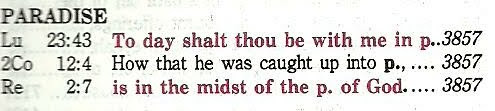
By this I am not denying continued spiritual advancement within the recapitulated world and universe for citizens of the Kingdom of God, but from this present, temporal realm, human sinful nature and sin will have ended in the body at the resurrection, and I assume in spirit. The believer shall be holy while waiting for the resurrection in paradise (Luke 23, 2 Corinthians 12: 4).

Paradise


Image one: Strong, page 1035

Image two: Strong page 72.

Image three: Marshall page 257 from Luke 23

Image four: Marshall page 545 from 2 Corinthians 12: 4

Image five: Marshall page 727 from Revelation 2: 7

Image six: Bauer page 214

There is also the issue of Paul's 2 Corinthians reference and his willingness to consider departing the body to be with the Lord in Philippians 1.

Bauer on page 614 describes paradise from Luke 23, 2 Corinthians 12 and Revelation 2 as a place above the earth. Now from my philosophical/theological perspective I do not take this plain literally, as in some place in the clouds, or above the clouds, or even beyond the solar system or beyond the physical Universe, as in a place that can be physically found via space/travel. 

The Bible teaches that paradise is a place where spirits in Christ go after death, and Old Testament/Hebrew Bible saints went to spiritually after death. The Bible teaches this using figurative literal language. Therefore, I would conclude paradise is a place of the non-physical spiritual realm. 

The Luke 23, 2 Corinthians 12: 4 and Philippians 1 sections to me read as a spiritual, non-physical environment. 

However, for balance, the Revelation 2: 7 reference might be in the context of the future, restored, recapitulated creation (Revelation 20-22), as in a new restored Eden. This would be a different 'paradise' than in Luke 23, 2 Corinthians 12: 4 and Philippians 1.

Paradise may consist of, and I state may consist of, a simulated physicality that seems like earth to the persons that are there. On the other hand there is the school of thought that when one dies in Christ he or she may almost immediately awaken in the resurrected body making the paradise references strongly metaphorical as opposed to figurative literal. This will not be immediate, but will seem to be. This is certainly orthodox and possible, but I question whether Jesus meant this by the use of 'today' to the criminal on the cross. Strong notes that it has to do with now and present. Strong (1890)(1986: 87).

References from archives

Wednesday, January 16, 2013 Paradise Revisited


BAUER, W (1979) A Greek-English Lexicon of the New Testament, Translated by Eric H. Wahlstrom, Chicago, The University of Chicago Press.

BLOESCH, DONALD G. (1987) Freedom for Obedience, San Francisco, Harper and Rowe Publishers. 

CAIRNS, EARLE E. (1981) Christianity Through The Centuries, Grand Rapids, Zondervan Publishing House. 

ERICKSON, MILLARD. (1994) Christian Theology, Grand Rapids, Baker Book House.

GRENZ, STANLEY J. DAVID GURETZKI and CHERITH FEE NORDLING (1999) Pocket Dictionary of Theological Terms, Downers Grove, Ill., InterVarsity Press.

MARSHALL, ALFRED (1975)(1996) The Interlinear KJV-NIV, Grand Rapids, Zondervan.

STEEVES, P.D. (1996) 'Orthodox Tradition, The' in Walter A. Elwell (ed.), Evangelical Dictionary of Theology, Grand Rapids, Baker Books. 

STRONG, J. (1890)(1986) Strong's Exhaustive Concordance of the Bible, Pickering, Ontario, Welch Publishing Company.

THIESSEN, HENRY C. (1956) Introductory Lectures in Systematic Theology, Grand Rapids, Wm. B. Eerdmans Publishing Company.  

WHALE, J.S. (1958) Christian Doctrine, Glasgow, Fontana Books. 

WEBER, OTTO (1955)(1981) Foundations of Dogmatics,Volumes 1 and 2, Translated and annotated by Darrell L. Guder, William B. Eerdmans Publishing Company. 

WILLIAMS, ROWAN (2007) Wrestling with Angels, William B. Eerdmans Publishing Company, Grand Rapids.