Tuesday, December 04, 2018

The Orthodox Study Bible: Very non-exhaustive on salvation


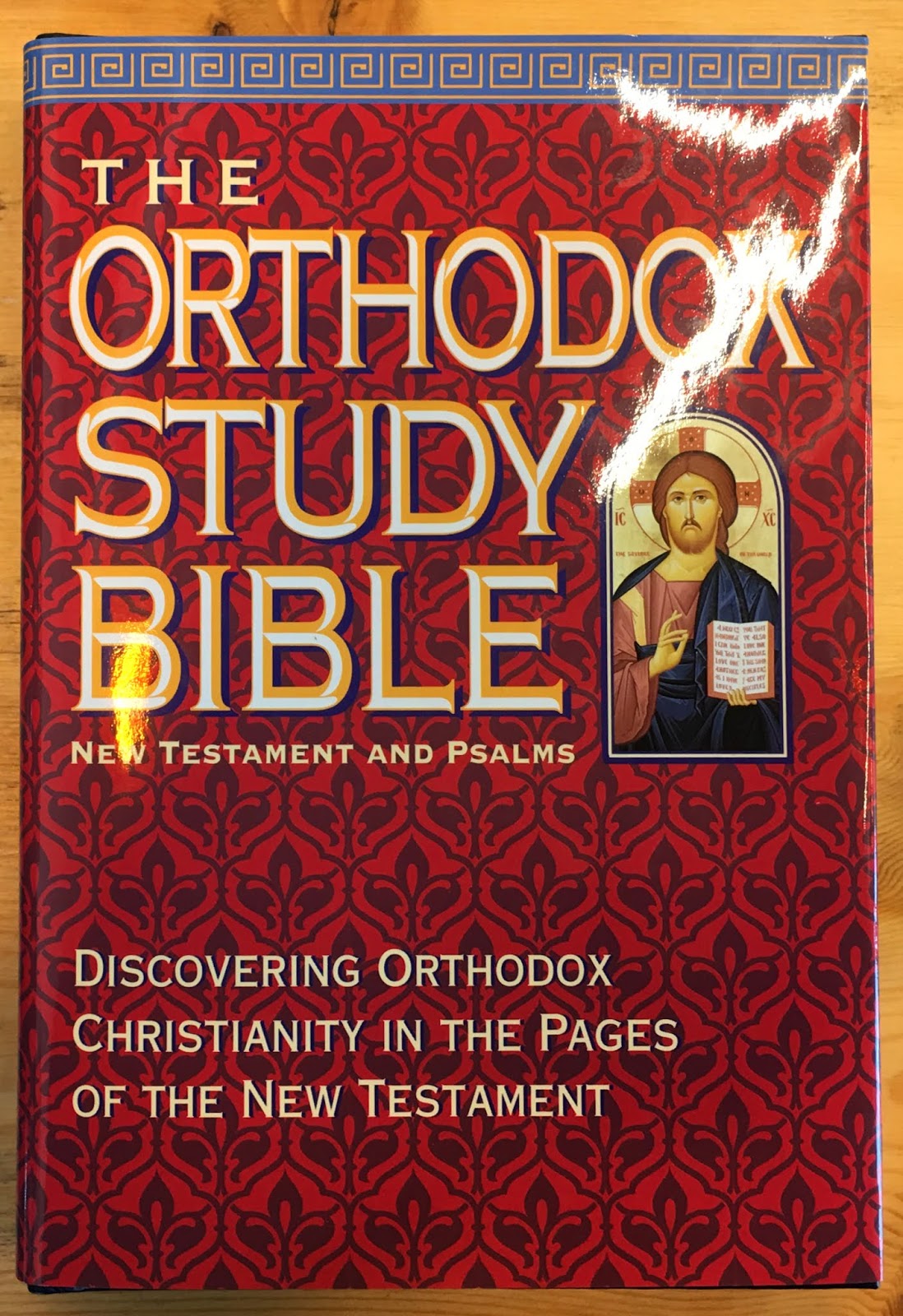
The Orthodox Study Bible, New Testament and Psalms, (1993) Saint Athanasius Orthodox Academy,Thomas Nelson Publishers, Nashville, Tennessee.

Purchased from my employer, the Canadian Bible Society @ Cafe Logos, Vancouver.

This text review continues...


Theology of salvation is compared:

1. Protestant

This presentation, in my view, is accurate in regards to a mainly Protestant/Evangelical theology which, based on my educational background and teaching on this website, heavily emphasizes libertarian free will.

(Incompatibilism, see archives, but it is non-determinism, in a sense)

In other words, if you believe in the gospel, you are saved, if you do not, you are damned.

However, the speaker, Steve Robinson documents on You Tube...

A comparison of the mainstream juridical-substitutionary atonement views and an Orthodox view of salvation illustrated with chairs.

It a limited Protestant perspective, in my view.

I view a Protestant/Reformed perspective as a significantly more theological astute and accurate than a merely a Protestant/Evangelical one.

By the planning, creation and initiation of the Father, Son and Holy Spirit...

The atoning and resurrection work of Jesus Christ is applied to those regenerated by the Holy Spirit (Titus 3) (One must be born again John 3), that with limited free will (my PhD take on compatibilism and soft determinism, see archives), embrace the work of Christ and the regeneration, simultaneous to God's salvific work.

This includes legal justification and the imputed righteousness of Jesus Christ to those chosen in Jesus Christ (Romans).

This includes sanctification.

Those in Christ are chosen (Ephesians 1, Romans 8-9), regenerated and are saved by grace through faith, not by works, but for works.

Works in Jesus Christ are however a sign of salvation (James).

Romans 4 for a New Testament view in regard to Abraham from the Hebrew Bible.

Romans 4:4-5, 20-22 New American Standard Bible (NASB)

What then shall we say that Abraham, our forefather according to the flesh, has found? 2 For if Abraham was justified by works, he has something to boast about, but not before God. 3 For what does the Scripture say? “Abraham believed God, and it was credited to him as righteousness.” 4 Now to the one who works, his wage is not credited as a favor, but as what is due. 5 But to the one who does not work, but believes in Him who justifies the ungodly, his faith is credited as righteousness

20 yet, with respect to the promise of God, he did not waver in unbelief but grew strong in faith, giving glory to God, 21 and being fully assured that what God had promised, He was able also to perform. 22 Therefore it was also credited to him as righteousness.

John Calvin: Romans 4: 5

Cited

He indeed clearly shews that faith brings us righteousness, not because it is a meritorious act, but because it obtains for us the favor of God.

2. Orthodox

In this video presentation, the love of God was heavily emphasized. I would appreciate a more thorough soteriology (salvation theology). But I understand it was a non-exhaustive presentation, as is my website article.
---

The Orthodox Study Bible defines Salvation
Page 807
However, here, is where Orthodoxy differs from Protestantism. As I noted in previous work, the Protestant view is that those in Christ do not cooperate in human salvation. My Reformed theology is that we embrace our salvation in Jesus Christ.

The second video below demonstrates that Pastor John F. MacArthur views Orthodoxy as false.

(MacArthur will view the Roman Catholic Church as false for similar reasons)

(Paraphrased) This would be based on this view described in the Orthodoxy text. He would understand Orthodoxy as holding to works righteousness and not justification by grace through faith alone. In other words, he reasons Orthodoxy assumes that the atoning and resurrection work in Christ is not sufficient for salvation.

Recent convert to Orthodoxy from Evangelical Christianity, Hank Hanegraaff of the Christian Research Institute, reasons (paraphrased) that MacArthur is interpreting Orthodoxy incorrectly and that the idea of cooperation with God in salvation connects to works in salvation concepts from the Book of James and not works righteousness for salvation.

I am learning about Orthodoxy, and so approach this topic cautiously and humbly, but will state that where and if MacArthur is correct, within Orthodoxy, that works righteousness will not save anyone.

As a Protestant within the Reformed tradition, again for clarity, I reason that God alone plans, creates, initiates salvation.

Based on my philosophical, Reformed theology...

Cause is a confusing philosophical term, and is used in different senses:

The chosen in Jesus Christ, as a secondary cause with limited free will, merely embrace salvation which is entirely of the triune God. Crucially, cause here is not defined as planning, creating or initiating salvation. Salvation is not forced or coerced by God, but humanly embraced.

To clarify:

Primary cause: God, as Father, Son, Holy Spirit, plans, creates, initiates the atoning and resurrection work of God the Son, Jesus Christ and regeneration.

Secondary cause: Chosen, regenerated Christians embrace.

A secondary cause as opposed to hard determinism and force and coercion, as human beings do not merely simply become Christians, but with limited free will, embrace salvation. As the soteriology is entirely divine, there is no human works righteousness that adds to or contributes to salvation.

If by works righteousness, concepts within James and Romans 4 (4: 22 Therefore it was also credited to him as righteousness) are meant, as in showing salvific faith by works and obedience, I can accept that as embracing salvation, but I would not use the term 'cooperation'.

Calvin's Commentaries, Vol. 38: Romans, tr. by John King, [1847-50], at sacred-texts.com

Monday, December 03, 2018

The Orthodox Study Bible: Heresy


The Orthodox Study Bible, New Testament and Psalms, (1993) Saint Athanasius Orthodox Academy,Thomas Nelson Publishers, Nashville, Tennessee.

Purchased from my employer, the Canadian Bible Society @ Cafe Logos, Vancouver.

This text review continues...

Definition

(Paraphrased)

The text defines heresy as following one's own choice or opinion instead of divine truth. (800). The truth is preserved by the Church. (800). Heresy causes division within the Christian Church. Heresy is a system of thought which contradicts true doctrine. (800). It is false teaching. (800).

I do not disagree with this definition...

Formally, heresy is doctrinal opposition to distinct Christian Church teaching.

But more loosely, by my Protestant, Reformed tradition and theology, I would state that theologically, heresy, also in a sense, is a denial of biblical doctrine which is indeed preserved within the Christian Church. It is preserved via biblical manuscripts and scholarship within the Christian Church which would include tradition.

From what could be considered a more liberal text, or at least as being from a more mainline Christianity perspective, as opposed to evangelical Christianity, which I purchased in England for my British, MPhil-PhD work:

S.W. Sykes explains that heresy was traditionally defined as a baptized person within the Christian Church then denying a key defined doctrine from the Church.(249). More formally, this is a continued adherence to such a denial of defined Church doctrine. (249).

M.R.W.Farrer writes within the Evangelical Dictionary of Theology, that heresy (in agreement with Sykes (249)) is from the Greek word 'hairesis', and means a choice (508). Heresy is a chosen position. (508).

Some New Testament parallels of this theological concept of heresy are ideas of false teaching, false prophecies, false doctrine, doctrines of demons, apostasy. Doctrines of antichrist and antichrists.

1 Timothy 4:1-3 New American Standard Bible (NASB)

4 But the Spirit explicitly says that in later times some will [a]fall away from the faith, paying attention to deceitful spirits and doctrines of demons, 2 by means of the hypocrisy of liars seared in their own conscience as with a branding iron, 3 men who forbid marriage and advocate abstaining from foods which God has created to be gratefully shared in by those who believe and know the truth.

Footnotes: 1 Timothy 4:1 I.e. apostacize

FARRER, M.R.W. (1996) ‘Baptism, Infant’, in Walter A. Elwell (ed.), Evangelical Dictionary of Theology, Grand Rapids, Baker Books.

SYKES, S.W. (1999) ‘Heresy’, in Alan Richardson and John Bowden (eds.), A New Dictionary of Christian Theology, Kent, SCM Press Ltd.

Saturday, December 01, 2018

The Orthodox Study Bible: Paradox


The Orthodox Study Bible, New Testament and Psalms, (1993) Saint Athanasius Orthodox Academy,Thomas Nelson Publishers, Nashville, Tennessee. 

Purchased from my employer, the Canadian Bible Society @ Cafe Logos, Vancouver. This text review continues... 

Cited

Definition of Paradox

That which is true, but not conventionally logical... (804).

The example listed is that of the virgin birth. From Matthew and Luke (Gospel), that a virgin (Mary) could remain a virgin and yet bear God the Son, as incarnate. (804).

Another example is the triune nature (trinity) of God, as God is one in nature, substance (Hebrews 1: 3 ὑποστάσεως my add) and yet be in three persons (I agree, but favour the term distinctions).(804).

I stated previously on this website, edited:

Philosopher Simon Blackburn explains a paradox arises when a set of apparently incontrovertible premises provides what would be viewed as unacceptable or contradictory conclusions. Blackburn (1996: 276).

John Etchemendy writes that seemingly sound reasoning based on assumptions leads to conclusions contradictory or obviously false. Etchemendy (1996: 558).

Blackburn uses the 'barber paradox' (page 36) where a village has a barber in it, who shaves all and only the persons that do not shave themselves. Therefore who shaves the barber? If he shaves himself, then he does not, but if he shaves himself, then he does. Blackburn (1996: 36). Blackburn provides the opinion that in reality philosophically there would be no such barber. The situation is inconsistent. Blackburn (1996: 36).

He references Russell's paradox and the class of all classes that are not members of themselves. 'If it is, then it is not, and if it not, then it is'. Blackburn (1996: 336).

Again an inconsistency and Blackburn notes what a 'class' is needs to be more clearly defined. With paradoxes such as these that arise in certain arguments within theology and philosophy it is often important to simply deny certain assumptions, premises, propositions that can lead to illogical, inconsistent and false conclusions.

I agree with Etchemendy as he stated paradoxes are often solved when mistaken principles or assumptions are found and rejected. Etchemendy (1996: 558).

BLACKBURN, SIMON (1996) Oxford Dictionary of Philosophy, Oxford, Oxford University Press. 

ETCHEMENDY, JOHN (1996) ‘Paradox’, in Robert Audi (ed.), The Cambridge Dictionary of Philosophy, Cambridge, Cambridge University Press.

Friday, November 30, 2018

The Orthodox Study Bible: Idol


The Orthodox Study Bible, New Testament and Psalms, (1993) Saint Athanasius Orthodox Academy,Thomas Nelson Publishers, Nashville, Tennessee. 

Purchased from my employer, the Canadian Bible Society @ Cafe Logos, Vancouver. This text review continues...

The Orthodox text's definition of Idol, there is not a definition for Idolatry:

A statue or other image of a false God; also, anything that is worshiped in place of the one true God. Money, possessions, fame, even family members can become idols if we put them ahead of God. (800).
---

Edited from archived entry

(Again, I do not want to reinvent the wheel with unneeded re-writes on this website)

Definitions of Idolatry

Browning writes that it is 'the cult surrounding a statue of a god or goddess'. Browning (1997: 181). 'Paul warns the Corinthian Christians about a kind of idolatry (I Corinthians 10: 14) which might have been a form of civic ceremony'. Browning (1997: 181).

'Idolatry is also used metaphorically for evil desires (Colossians 3:5)'. Browning (1997: 181).

This metaphorical use, I reason is the primary use of terms idol, idols, and idolatry in the Western evangelical church today.

Colossians 3:5 'English Standard Version (ESV)

5 Put to death therefore what is earthly in you:[a] sexual immorality, impurity, passion, evil desire, and covetousness, which is idolatry.

Footnotes: Colossians 3:5 Greek therefore your members that are on the earth'

P.C. Craigie defines idolatry as 'The worship of an idol or of a deity represented by an idol, usually as an image. Craigie (1997: 542).

He as did Browning acknowledges that the New Testament deals with idolatry in a more metaphorical context than the Hebrew Bible. Craigie (1996: 542). As in one should not covet for example (Ephesians 5: 5 and Colossians 3: 5).

Ephesians 5:5 English Standard Version (ESV)

'5 For you may be sure of this, that everyone who is sexually immoral or impure, or who is covetous (that is, an idolater), has no inheritance in the kingdom of Christ and God.'

Evil desires are the opposite of good desires (although human desires from present human nature, are always tainted, until the resurrection). Another way a stating this would be that the Holy Spirit is not being sought in evil desires, but sinful human desires are being followed. A theological key here is the idol becomes 'the immediate focus of a person's desires and 'worship' displacing the worship of God.' Craigie (1996: 543).
---

I am in agreement with Orthodox Bible that at idol is something placed ahead of God in importance.

In agreement with my edited archived work, an idol is a displacement of God.

For clarification, an idol is not an unmet need or desire that a regenerated Christian believer has that God is not meeting and causes stress and displeasure with God; an idol (idolatry) is biblically a replacement for God.

This distinction, in my humble opinion is too often misunderstood and/or ignored within evangelical church teaching.

Further, as I have written successfully accepted, biblical, Reformed, MPhil/PhD theses on the problem of evil and continued my work on this website, I can reasonably opine that many problems of evil are shuffled off as idols in ill-fated attempts to bring overly-simplistic remedies to problems of evil within the evangelical church.

BROWNING, W.R.F. (1997) Dictionary of the Bible, Oxford, Oxford University Press.

CRAIGIE, P.C. (1996) 'Idolatry', in Walter A. Elwell (ed.), Evangelical Dictionary of Theology, Grand Rapids, Baker Books.

ORR, R.W. (1986) I John, in F.F. Bruce (ed.), The International Bible Commentary, Grand Rapids, Zondervan.