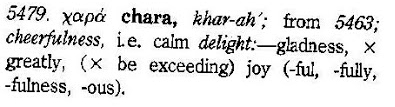
This free pamphlet provides some biblical, New Testament verses in regard to Joy and Joy to the World. This is available from Cafe Logos, the Canadian Bible Society @1207 Kingsway,Vancouver.
Joy To The World, Canadian Bible Society (2018).
We are in our soft opening and receiving positive public response.
Reviewing this today, theologically, a reasonable, true, non-exhaustive, definition for Joy is that Joy is from God to the believer in Jesus Christ; and is pleasure in experiencing God, despite circumstances.
Happiness, in contrast is more based on circumstances.
From the archives of my second website, Satire Und Theology...
Browning reasons Biblical 'joy' is more than an emotion, as it combines a sense of human happiness with a state of blessedness. In the Old Testament it is marked by festivals (Deuteronomy 12) and by settlements of grievances brought to the Temple (Psalms 43). In the New Testament he explains that 'joy' is prominent in Luke/Acts due to the gifts of the Holy Spirit, which can also be seen in Galatians 5. Browning (1997: 210).
Creath Davis explains 'joy' is a delight in life that goes deeper than pain or pleasure and from a Biblical perspective would not be limited or tied to external circumstances. Davis (1999: 588). 'Joy' is given from God as a gift and can be experienced during very difficult and extreme circumstances. Davis (1999: 588).
In both Testaments 'joy' is presented as sign of one being a believer and a sign in the believing community, it is a quality of life and not simply an emotional reaction or feeling. Davis (1999: 588). This 'joy' comes from God (Psalms 16, Romans 15), and is an aspect of faith and one's life with God. Davis (1999: 588). 'Joy' is also connected to weakness and suffering when it has redemptive purpose and is bringing persons to depend on God (Matthew 5 and 2 Corinthians 12). Davis (1999: 588).
Further, Davis mentions that psychologically one cannot experience 'joy' while being preoccupied with self-security, pleasure, or self-interest. Davis (1999: 588). There is a freedom that comes when God alone is the 'only adequate center for human existence, and God alone can enable persons to experience life with joyous spontaneity and to relate to others with love.' Davis (1999: 588)
From Strong. Two of the main examples of 'Joy', one from the Hebrew Bible and one from the New Testament.
Page 104
Page 156
BROWNING, W.R.F. (1997) Oxford Dictionary of the Bible, Oxford, Oxford University Press.
DAVIS, CREATH. (1996) ‘Joy’, in Walter A. Elwell (ed.), Evangelical Dictionary of Theology, Grand Rapids, Baker Books.
STRONG, J. (1890)(1986) Strong's Exhaustive Concordance of the Bible, Burlington, Welch Publishing Company.
Since I was fairly young, I have found the Church of Jesus Christ of Latter-day Saints, theologically and culturally, interesting. I have attended the open house at the Vancouver Temple (Langley) at its beginning and toured Temple Square in May. I have been to the local Mormon church, once, for a public gathering.
I consider myself friendly to Latter-day Saints, and their various versions, and only friendly, although my theology, being biblical and Reformed/Protestant, is vastly different, as is my worldview. I appreciated their kindness to me on the occasions I visited. I appreciated the tours. This is not an attack, it is a theological (philosophical, biblical) comparison in brief.
Further, I have been watching Mormon Christmas specials, from time to time over the years, not because I am interested in Christmas music; no not very much, although the performances seem first rate.
I am interested in the culture of belief. In other words, in my view, there are very strong emotional and cultural reasons persons embrace Mormonism (and persons that embrace other worldviews, religious and otherwise).
Being the oddball I am, I am one of the minority on the planet that primarily bases my worldview on researched theology (scriptural) and philosophy, while I do give God the credit as the philosophical first cause and the one that theologically regenerates my spirit and person through the Holy Spirit (John 3, Titus 3).
So, in kindness, here are some differences in views.
Theology/Philosophy
At approximately 39: 58-59, Mr. Hugh Bonneville (paraphrased) names the Christmas birth of Jesus Christ and his example showing God's love that does overcome the darkness and evil.
A Christmas example...
I realize he is a performer, but still he is representing their Church at this point, publicly.
In contrast:
The incarnation of Jesus Christ, God the Son actually leads to his crucifixion and his atoning (see gospel accounts on the crucifixion) and resurrection work (1 Corinthians 15) for those chosen and predestined by God (Ephesians 1).
Christ's work in life and in death, as example is rather secondary theologically and in regards to overcoming evil. (See my archives for vast MPhil/PhD work on the problem of evil)
It is secondary, as no finite, sinful human being can duplicate it, so as an example it has its fatal limitations!
Atonement, in particular, examples:
Romans 5:7-8 New American Standard Bible (NASB)
7 For one will hardly die for a righteous man; [a]though perhaps for the good man someone would dare even to die. 8 But God demonstrates His own love toward us, in that while we were yet sinners, Christ died for us. Footnotes: Romans 5:7 Lit for
1 Corinthians 15:3-4 New American Standard Bible (NASB)
3 For I delivered to you [a]as of first importance what I also received, that Christ died for our sins according to the Scriptures, 4 and that He was buried, and that He was raised on the third day according to the Scriptures,
Footnotes:
1 Corinthians 15:3 Lit among the first
Hebrews 10: 10-14 New American Standard Bible (NASB)
10 By this will we have been sanctified through the offering of the body of Jesus Christ once for all.
11 Every priest stands daily ministering and offering time after time the same sacrifices, which can never take away sins; 12 but He, having offered one sacrifice for sins for all time, sat down at the right hand of God, 13 waiting from that time onward until His enemies be made a footstool for His feet. 14 For by one offering He has perfected for all time those who are sanctified.
Salvation from Sin. To be cleansed from sin through the Savior’s Atonement, an individual must exercise faith in Jesus Christ, repent, be baptized, and receive the gift of the Holy Ghost (see Acts 2:37–38). Those who have been baptized and have received the Holy Ghost through the proper priesthood authority have been conditionally saved from sin. In this sense, salvation is conditional, depending on an individual’s continuing in faithfulness, or enduring to the end in keeping the commandments of God (see 2 Peter 2:20–22). Individuals cannot be saved in their sins; they cannot receive unconditional salvation simply by declaring a belief in Christ with the understanding that they will inevitably commit sins throughout the rest of their lives (see Alma 11:36–37). However, through the grace of God, all can be saved from their sins (see 2 Nephi 25:23; Helaman 5:10–11) as they repent and follow Jesus Christ. ---
I differ from this approach, as theologically we are saved by the atoning work (and resurrection work) of Christ by regeneration, through grace through faith (Romans, Galatians, Ephesians 2).
Biblical repentance is a result during regeneration, simultaneously in conversion of the work initiated by God. No one is going to receive the Holy Spirit without being first regenerated by the triune God.
A proper priesthood authority, biblically has nothing to do with salvation and brings us theologically, firmly to work's righteousness, which is in fatal contrast to the historical, biblical gospel.
A proper priesthood authority, biblically has nothing to do with salvation and brings us theologically, firmly to work's righteousness, which is in fatal contrast to the historical, biblical gospel. Hebrews discusses Jesus Christ as the high priest and mediator of the new covenant. His atoning work makes a priesthood obsolete.
The Latter-day Saints claim to provide a restored gospel, but it is not a biblical one (Galatians 1).
Salvation is not conditional on work's righteousness (again Romans, Galatians, Ephesians 2) and by keeping the commandments of God as the human nature (desires, will, choice) is corrupted by sin and unable to begin or maintain a work's righteousness for salvation.
I reason that God alone plans, creates, initiates salvation. Regenerated human beings, embrace the gospel work of salvation for salvation. Human righteousness, and good works arise from salvation but do not create or maintain salvation. Even when guided by the Holy Spirit, this righteousness and good works remains humanly tainted until the resurrection (1 Corinthians 15, Revelation 21-22), while God remains holy.
The Orthodox Study Bible, New Testament and Psalms, (1993) Saint Athanasius Orthodox Academy,Thomas Nelson Publishers, Nashville, Tennessee.
Purchased from my employer, the Canadian Bible Society @ Cafe Logos, Vancouver.
This text review continues...
This Christmas Eve, almost Christmas Day, in the Pacific time zone, I share from this scholarly text some academic, intellectual support for incarnation of God the Son, the eternal Word.
Contrary to some, theologically and philosophically, I do not view sin against the infinite God as infinite. Sin had a beginning and is, in fact, finite, not infinite.
Ontologically, God (and attributes) is the only infinite entity.
This text is correct that within the New Testament atonement, it took a perfect man and the perfect God, and I will add the infinite God, to outlast and atone for the human sin against the infinite, eternal God.
The Orthodox Study Bible, New Testament and Psalms, (1993) Saint Athanasius Orthodox Academy,Thomas Nelson Publishers, Nashville, Tennessee.
Purchased from my employer, the Canadian Bible Society @ Cafe Logos, Vancouver.
This text review continues...
Although from theologians, philosophers, biblical scholars and scientists, alike, there would be much debate on the degree of biblical literalness in regard to the new heaven and new earth, I have written on this previously on this website (edited).
---
Mounce acknowledges that Isaiah did mention the concepts of a new heaven and new earth. (368). This he documents within Isaiah, Chapters 65-66. (368). He notes that 'renovation of the old order is a concept which belongs to the common stock of apocalyptic tradition.' (369).
This is restoration theology as opposed to a theology of ex nihilo recreation.
The creation is renewed. (369).
Mounce states:
'Probably the new order of things is not to be thought of primarily as a physical transformation.' (369).
Mounce reasons that most scholars allow for varying levels of literal interpretation in regard to the new creation. (369).
In contrast, others views presented support largely plain literal interpretations of eschatological and creation texts, at times within a dispensationalist tradition.
Mounce further demonstrates the rather figurative literal (not mythological) nature of this eschatological language in Revelation.
The reference to 'no longer any sea' (New American Standard Bible, my add) is likely a reference to a dread of the sea by many ancient cultures. The sea was viewed as an evil.
To state that through the metaphorical use of 'sea' that evil will no longer exist in the new order, seems far more intellectually palatable than attempting to explain the lack of major water bodies in a new creation within an everlastingly liveable universe for human beings.
Although resurrected persons have a spiritual body (1 Corinthians 15: 44), they still have physical qualities and live in a physical universe. As resurrected human beings in Christ still have a restored, physical nature and attributes, quite reasonably, the universe and earth should also have restored physical attributes. Perhaps a restored earth will be similar to the pre-fall Garden of Eden? But the entire earth and universe. Perhaps it will have more spiritual aspects than at present?
David F. Payne in his 2 Peter commentary opines that everything on the earth will be 'laid bare', is probably a more correct text than stating everything will be 'burned up'. (1569). This would lead to the theology of eschatological restoration as opposed to eschatological recreation.
---
In basic agreement, I find the entry below within the Orthodox Study Bible, quite academic and reasonable. I tentatively and cautiously hold to figurative literal (a degree of literalness) theology with the new heaven and new earth.
Page 630
MOUNCE, ROBERT H. (1990) The Book of Revelation, Grand Rapids, William B. Eerdmans Publishing Company.
PAYNE. DAVID F.(1986) ‘2 Peter’, in F.F. Bruce, (ed.), The International Bible Commentary, Grand Rapids, Marshall Pickering/Zondervan.